

★★★★★
The clinic was very professional from start to finish. Doctor Jung was excellent and gentle with the treatment. I felt well looked after and everyone was outstanding. Happy with my service!
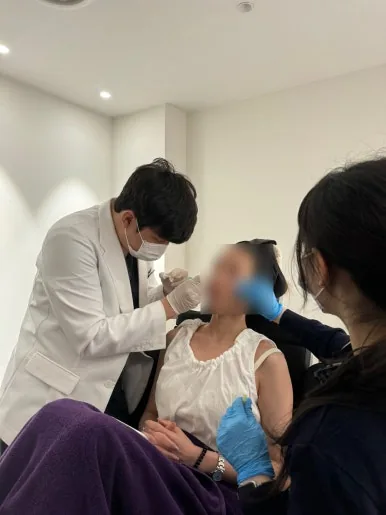
Threads along a jaw border are sold by the line, and each line is bought for the direction it pulls in. This page sets out the vectors used at the mandible, what a thread can and cannot move there, and the two thread types on our card.
Two words do the work. Vector is the direction a thread pulls in; anchor is the point in firmer tissue where that pull is held. A jaw border answers to threads because the tissue blurring it has travelled downward and forward along a predictable path, and a thread set on the reverse path takes it back. The procedure across every facial area is on the thread lift page; this one stays at the mandible.
Jaw width is a separate question, coming from the chewing muscle and answering to botulinum toxin; a jaw angle that never projected is structural, and belongs to jawline filler. A thread moves tissue that has travelled. It builds no bone line and relaxes no muscle.

Four parts of one jawline thread, in the order they are planned on your EVE Muse 3D scan.
Every thread pulls against something. At the mandible the holding point sits above and behind the border, in tissue that has not travelled. An anchor set in slack tissue migrates with it, and the lift goes with it.
The cannula travels a planned line between anchor and target, at a depth chosen so the thread sits under the skin without tethering it. That depth is the difference between a smooth pull and a visible one.
Barbs along a PDO or PCL thread, or paired cones on a Silhouette Soft line, engage tissue that has dropped onto the jaw and hold it where the director places it. Grip is what converts a path into a lift.
Pull a jaw border straight up and the cheek bunches. Pull it back without lifting and the line stays soft. The mandible wants an oblique angle between the two, drawn on your own scan before a cannula is opened.
Thread count follows from all four, and it is the last number settled. A border blurred along its whole length needs more lines than one softened only at the angle, and each line is its own figure on your quote at ₩100,000 (≈ $70).
Both are absorbable, both are placed by vector, both are published per line.
| Thread | How it holds tissue | Sold in | Where it fits at the mandible | Listed rate |
|---|---|---|---|---|
| PDO / PCL barbed thread | Fine cogs cut or moulded along the body of the thread engage tissue at several points down its length | Per thread | The everyday line for a border that has blurred along its length, and the one most jaw plans are built from | ₩100,000 (≈ $70) |
| Silhouette Soft cone thread | Paired cones set in opposing directions hold from two sides of a knot, giving firmer fixation at fewer points | Per thread | Chosen where the border needs stronger purchase than a barbed line gives, alone or in a mixed plan | ₩400,000 (≈ $285) |
Two published lines, one border. Which your plan uses, and in what mix, comes from skin thickness and how far the tissue has travelled. The whole card sits on the published price list, and the lifting and tightening page places threads beside every energy platform here.
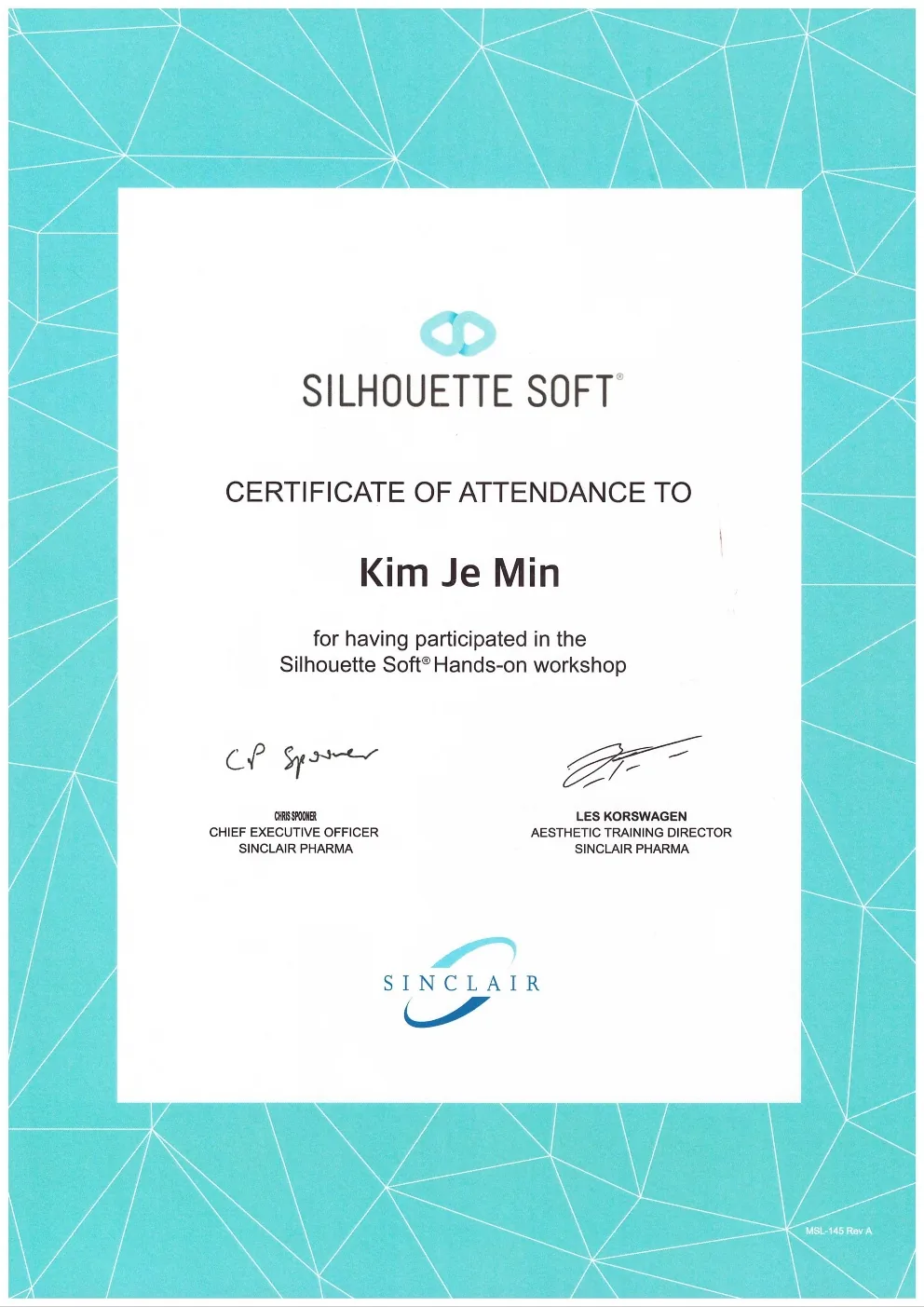
Directors at Dear Clinic have completed the Silhouette Soft hands-on workshop (certificate of attendance). Cone and barbed threads behave differently under the hand, and technique does not transfer between them unchanged.
Four limits, each of which redirects an enquiry to another room on these floors.
One more limit belongs here. Threads are absorbable, so the mechanical lift is finite by design, and collagen laid down along each path carries on afterwards. How long that holds varies with age, skin thickness, weight change and how far the tissue had travelled, so your director gives you a conservative expectation and a review date.
Threads move tissue; energy asks tissue to contract. Faces often present with both findings at once.
Ultherapy Prime places energy in discrete points at 1.5, 3.0 and 4.5 mm with imaging to 8 mm, addressing deep support a vector cannot supply. Shurink Universe covers the same family at a different session size. Whether either shares a visit with threads is a decision your director makes on the day.
Thermage FLX heats a wide dermal field through a sealed tip, which answers the surface quality a thread never touches. Sequencing matters more than pairing here, and the interval is written into your plan.
Where width from the chewing muscle or a short chin is also present, those are settled first, because a vector drawn over an unsettled base has to be drawn again. How toxin slims a jawline covers the muscle side.
The straight comparison between the two families — mechanical against thermal, same day against weeks — is laid out on thread lift versus HIFU and radiofrequency. One paper in the reference list below examines that pairing directly, which is why the question is raised at diagnosis.
One unretouched case, shown with consent, a week after placement.
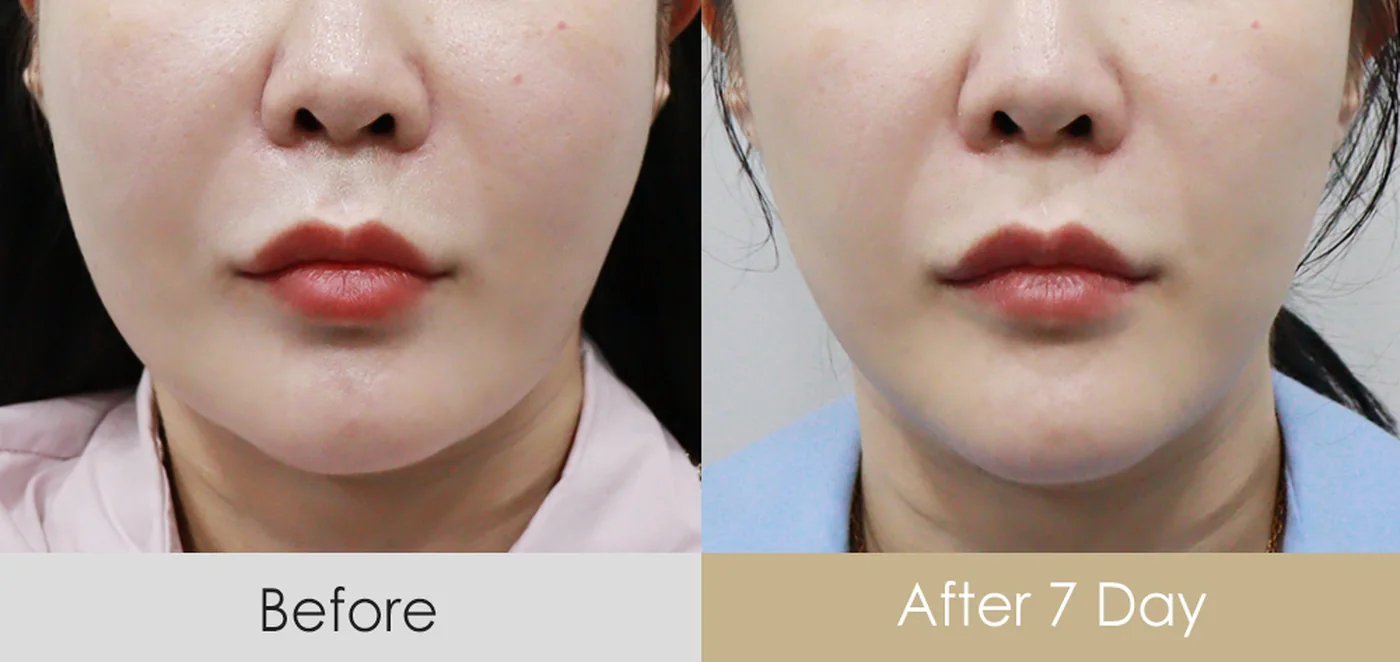
This photo is an unretouched before/after case of the same person under the same conditions, treated at Dear Clinic and shown with consent. Individual results may vary; no specific outcome is implied or promised.
Read any jaw comparison with the chin at the same height in both frames, because two centimetres of chin lift sharpens a border by itself. Swelling also flatters a jaw early on, so a seven-day image carries vector and swelling together. Your own review is set for a point where the two have separated.
Ultherapy Prime, Thermage FLX, Density, XERF, Onda, New Titanium and Shurink Universe sit across 5F and 7F beside the toxin and filler lines. No console needs your booking to stay busy, so a consultation ending in no threads costs us nothing to give.
The face is captured in three dimensions under five light sources with AI analysis, and the direction your lower face has travelled is read before a thread type is named. Every line on the quote traces back to a vector on the map.
Angle, depth and symmetry decide what a jaw thread does, and all three live in the hand. Your session is director-performed by the doctor who read your scan, each side checked against the other before the next line goes in.
Per-line pricing is easy to audit, which is why it is published that way. A focused plan at the angle of the jaw is a handful of lines; a border blurred from chin to angle on both sides is more. You approve the count and the arithmetic before the first pass, and lines are not added once a session has begun.
International visitors pay the same published figures as Korean patients, with no surcharge. Korean won is what you actually pay; a USD figure beside it is an approximate reference. Consultation and aftercare arrangements are explained at your appointment.
If the scan says your border has not travelled far enough for a vector to earn its line, that is the sentence you get, and it costs us the booking.
Where the finding is surface laxity with the border intact, where the weight under the jaw is beyond what a vector can carry, or where the anatomy underneath never cast a line, a thread lift is not the right tool, and we say so at the consultation. Threads are not placed through skin with active infection or inflammation at the entry points. Tell your director about blood thinners, easy bruising, keloid scarring, previous permanent threads or facial surgery, pregnancy and breastfeeding — several change the plan and one or two rule the procedure out.

Outcomes differ between individuals and are assessed at your in-person diagnosis.
Numbness or altered sensation along the jaw can follow any work in this field and usually resolves. Scar tissue from surgery or earlier threads changes how a vector behaves, so disclose it before the map is drawn.
Director-performed treatment is a Dear promise — your procedure is planned and performed by the doctors below.





Real verified reviews from our Google Business Profile.
4.9★★★★★ 310 Google ReviewsThe clinic was very professional from start to finish. Doctor Jung was excellent and gentle with the treatment. I felt well looked after and everyone was outstanding. Happy with my service!
I've visited clinic for LDM procedure. I don't speak Korean, so there was an interpreter who assisted me while consulting. The staff was very attentive, they asked me every time before applying products/covering my face during the procedure and it went smoothly. Planning to visit the clini…
All the staff are kind, the doctor is professional. They recommended us the treatment that fit us best and last the longest. A very nice experience overall.
I did a hydrofacial, white/black head removal, and 1 day lasers. Really kind staff and reasonable prices. The only thing I would advise is that your first consultation is with a salesperson and you don’t see the doctor until after you decide what you want and after you pay.
Had a great experience here as a foreigner! The doctors and staff were knowledgeable, friendly, and not pushy. They made recommendations in my consultation and were happy to work within my budget.
Your questions, answered in English as soon as possible.
The three entries below are indexed studies of absorbable suspension threads: a two-year assessment of barbed PDO threads, a report on facial thread lifting by suture suspension, and a safety paper on combining suspension threads with micro-focused ultrasound.
Each carries title, journal, year and a verifiable DOI, and none is evidence of an outcome for your own jaw border.
References are provided for information — outcomes vary by individual and are assessed at your diagnosis.