

★★★★★
The clinic was very professional from start to finish. Doctor Jung was excellent and gentle with the treatment. I felt well looked after and everyone was outstanding. Happy with my service!
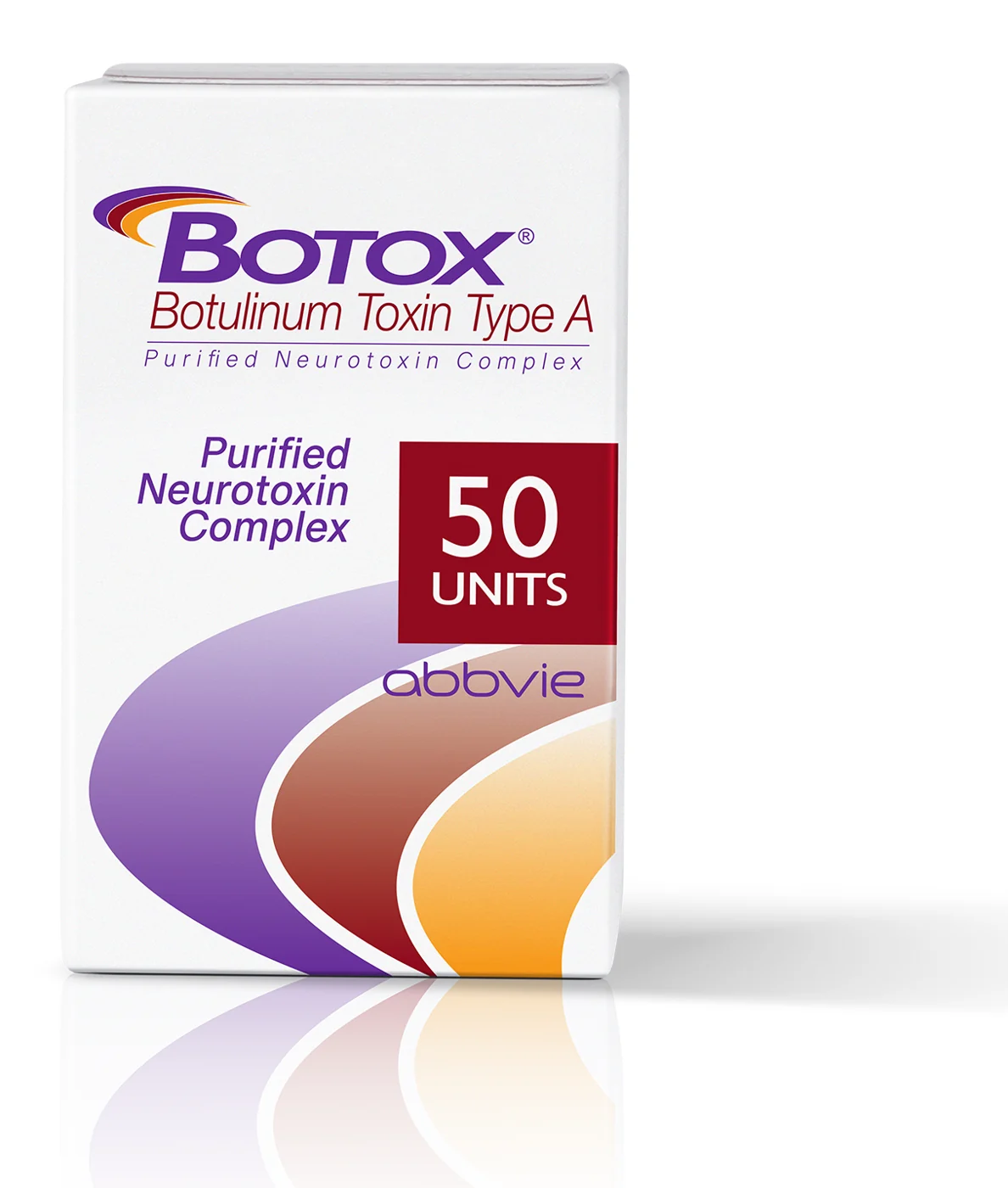
Toxin quietens the signal reaching a muscle, so lines made by movement fold less and a bulky muscle slims. A thread physically moves slackened tissue and holds it there. Two different problems. Wrinkle areas from ₩30,000, threads from ₩100,000 each.
Patients often arrive having read that one is the modern choice and the other the traditional one, and that framing sends people to the wrong route. The useful question is mechanical: is the tissue in the right place and moving too much, or in the wrong place and needing to be carried back? A pen, a mirror and an examination settle it in minutes.
Both are performed at Dear Clinic and both appear on the published rate list, so neither has a commercial advantage here. What follows is the working difference, the cases that go to each, and the risks you would be accepting in either direction.
Threads are absorbable. Over months the material breaks down and is cleared, and the vector is progressively held by the tissue response along the path instead of by the thread itself. Toxin wears off too, on the product's own schedule. Neither route is a one-time purchase.
Expression lines that deepen when the face works. A masseter thickened until the lower face reads square, treated on the square jaw line. A neck or jawline where fine surface crinkling is the complaint, treated shallowly on the skin botox line. Each sits in its own place on the rate list.
A jaw border blurred by tissue that has slid forward and down. A mid-face that used to sit higher. Fold depth at the mouth corners caused by what rests on it. These are position problems, and a thread lift moves position on the day it is performed.
A hollow that needs filling, sun damage sitting in the skin, or a lower face carrying weight well beyond what a vector can hold. Where the examination finds one of those, we do not recommend either route and the conversation moves to the tool that fits, up to a surgical opinion.
A jawline is where the two get confused most, because a square outline and a sagging outline both read as a lost jaw in a photograph. One is muscle width and the other descent; telling them apart is a hand on the clenched jaw and a look at where the border sits when you lie back. The wider set of routes for a dropping lower face is on the jowl sagging page.
| Botulinum toxin type A | Absorbable suspension threads | |
|---|---|---|
| What it does | Reduces the signal reaching a chosen muscle, so it contracts with less force | Grips descended tissue and holds it along a path fixed to firmer tissue above |
| Layer treated | The muscle itself, or the plane just under the skin for surface work | The subcutaneous plane above the muscle, with the anchor set higher |
| Quoted by | Treated area, or by unit load on the body lines | Per thread, with the count agreed before the first pass |
| When it shows | Nothing on the day; movement changes over the days that follow | On the table, with swelling settling over the following period |
| Recovery | Entry marks, occasional bruising, ordinary activity the same day | Swelling, tenderness and a pulling sensation; chewing and sleeping adjusted for a period |
| Listed rate | Wrinkle area ₩30,000 (≈ $20) · square jaw ₩40,000 (≈ $30) · skin botox ₩100,000 (≈ $70) | PDO/PCL thread ₩100,000 (≈ $70) each · Silhouette Soft ₩400,000 (≈ $285) each |
Korean tier rates are shown in the toxin column; imported tiers for every toxin line are published on the price list. Thread totals depend on the count your vector needs, agreed with you before the first pass and never adjusted during the appointment. Rates are identical for residents and visitors, and any consultation or aftercare charge is confirmed at the appointment.
A lower face that reads wide, firm and square. Clench, and a block of muscle stands out at the angle of the jaw. The outline is in the right place and simply too broad. This is a toxin case, worked on the square jaw line, and threads would add a vector to a face that has not descended.
A jaw border that has gone soft and moved forward. Lying back flat, the outline you remember reappears; standing up, it disappears again. Tissue has travelled, and nothing about how hard a muscle contracts is responsible for it. This is a thread case, and the number of threads follows the length of the vector the examination draws.
A face carrying both at once. A heavy masseter and a slipped jaw border are common together, and the order matters. The muscle question is usually settled first, because a lower face changes shape as a wide muscle narrows and a vector drawn across it beforehand is wasted. Your director gives you the order and the reason.
Where both are indicated, the muscle is addressed first and given time to settle, and the vector is drawn afterwards on a lower face that has stopped changing shape. Upper-face expression work raises no such timing question and sits alongside a lower-face vector comfortably. Threads beside energy platforms are a separate pairing, covered on the thread lift against focused ultrasound page.
What we avoid is stacking two treatments in one appointment simply because both were on your list. Each is quoted separately, each is approved by you separately, and where your director thinks the second should wait, you hear that at the consultation and not at the till.
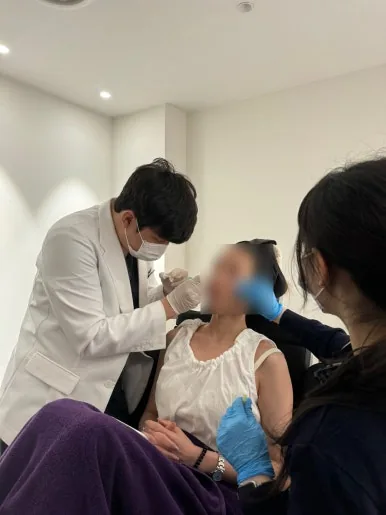
The mechanical half of this comparison is visible on the day it is done. A toxin result is a change in movement over weeks and belongs to a review appointment, so it is described here in words instead.
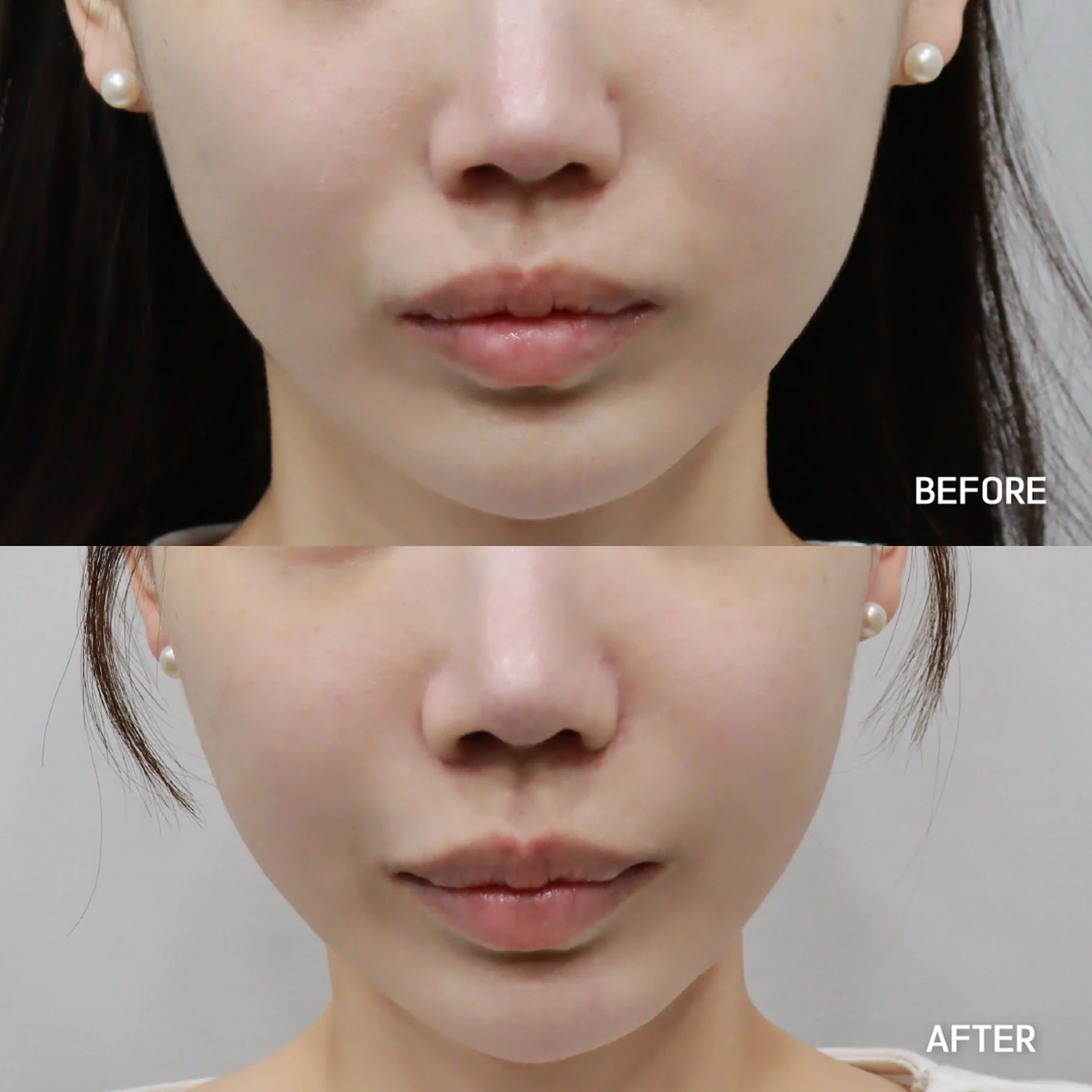
An unretouched before/after case of the same person under the same conditions, treated at Dear Clinic and shown with consent. It illustrates only the treatment it is labelled with. Individual results may vary; no specific outcome is implied or promised.
Toxin fails by spreading or by dosing. Product reaching a neighbouring muscle produces effects nobody wanted: a heavy brow or lid in the upper face, an altered smile or a weaker bite when a lower-face muscle takes more than intended. Asymmetry between the sides is the commonest thing a review corrects, and chewing fatigue is normal for a period after a masseter dose. All of it is temporary, which is a comfort and a limit at once, since waiting is the only way out.
Threads fail mechanically. Skin can dimple or pucker where a barb caught too close to the surface, the two sides can settle unequally, and a strand can stay palpable or work its way toward the surface. Because entry points are made, infection along the track is an uncommon but real risk, and spreading redness, discharge or fever is a same-day telephone call. A pulling sensation on wide opening is expected early and settles.
When we do not recommend either. Toxin is declined in pregnancy and while breastfeeding, where a neuromuscular condition sits in your history, and where there is infection or inflamed skin in the field. Threads are declined on an active skin infection in the path, on a face where laxity is well past what a vector can carry, and where a bleeding disorder or blood-thinning medication makes the passes unwise. Tell your director about blood thinners and supplements, any previous reaction to a toxin, and any work already done in the area. Results vary between individuals and are assessed on your own examination.
Toxin lines and thread lines are both published here, alongside seven lifting platforms, so neither route needs defending.
Three-dimensional capture under five light sources records the face at rest, in movement and lying back, and the AI analysis compares them. What moves belongs to the muscle conversation; what changes between upright and reclined belongs to the vector conversation. That separation is made before either route is named.
Both routes are director-performed. Injection points and thread vectors are drawn on your own face at the appointment, counts and totals are agreed before anything starts, and the record is kept so a later visit begins from what was actually done.
Director-performed treatment is a Dear promise — your procedure is planned and performed by the doctors below.





Real verified reviews from our Google Business Profile.
4.9★★★★★ 310 Google ReviewsThe clinic was very professional from start to finish. Doctor Jung was excellent and gentle with the treatment. I felt well looked after and everyone was outstanding. Happy with my service!
I've visited clinic for LDM procedure. I don't speak Korean, so there was an interpreter who assisted me while consulting. The staff was very attentive, they asked me every time before applying products/covering my face during the procedure and it went smoothly. Planning to visit the clini…
All the staff are kind, the doctor is professional. They recommended us the treatment that fit us best and last the longest. A very nice experience overall.
I did a hydrofacial, white/black head removal, and 1 day lasers. Really kind staff and reasonable prices. The only thing I would advise is that your first consultation is with a salesperson and you don’t see the doctor until after you decide what you want and after you pay.
Had a great experience here as a foreigner! The doctors and staff were knowledgeable, friendly, and not pushy. They made recommendations in my consultation and were happy to work within my budget.
Send one photograph straight on and one in three-quarter profile, face relaxed — answered in English as soon as possible.
Six references, three per route. On the toxin side: the original report of treating a facial muscle group with botulinum toxin type A, a consensus education initiative on its aesthetic use, and a laboratory account of how the licensed type A products differ. On the thread side: a two-year outcome study of absorbable barbed threads, a surgical account of facial lifting with suture suspension, and a safety study of threads combined with micro-focused ultrasound.
They establish mechanism and published experience for each route. They do not describe your face, set no dose and no thread count, and attach no timeline to either; that comes from the examination carried out on you.
References are provided for information — outcomes vary by individual and are assessed at your diagnosis.