

★★★★★
The clinic was very professional from start to finish. Doctor Jung was excellent and gentle with the treatment. I felt well looked after and everyone was outstanding. Happy with my service!
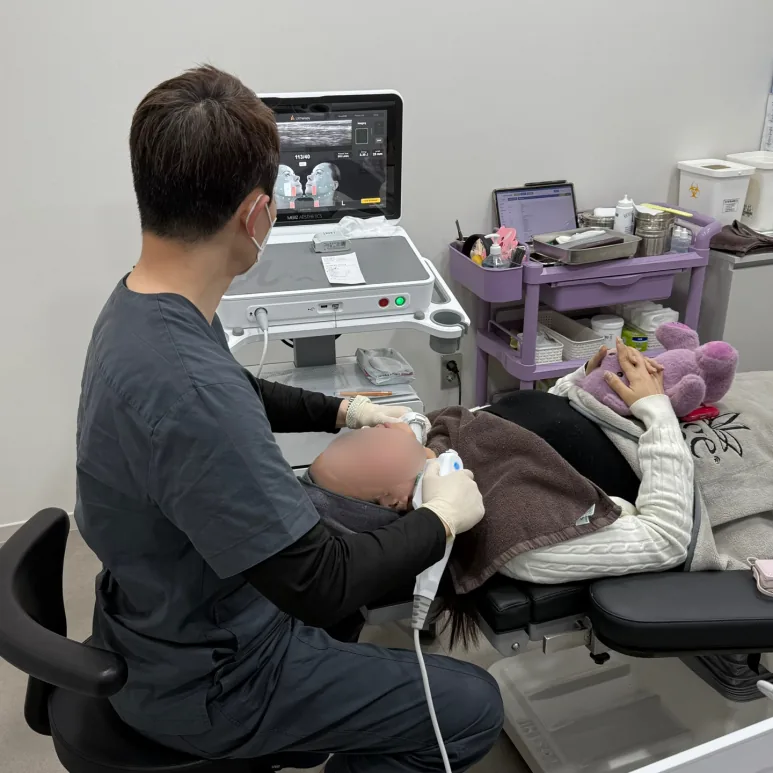
Focused ultrasound concentrates energy into separate points at a set depth. Monopolar radiofrequency warms a whole volume of tissue that its field passes through. Every other difference between the two families — the layer treated, the unit you are billed in, how a session feels — follows from that one distinction.
Follow the consequence and the rest of the comparison writes itself. Because ultrasound converges, the depth of the focal point can be selected, which is how a treatment reaches the fibrous support layer beneath the fat while leaving the skin above it alone. Because radiofrequency spreads, depth is governed by field geometry and surface cooling, so what it reliably treats is the thickness of skin the field crosses.
Both families are installed on these two floors and both are run daily, which is why this page can afford to describe them plainly. The full list of lifting platforms sits on the lifting and tightening page, and the lifting guide starts further back than this comparison does.
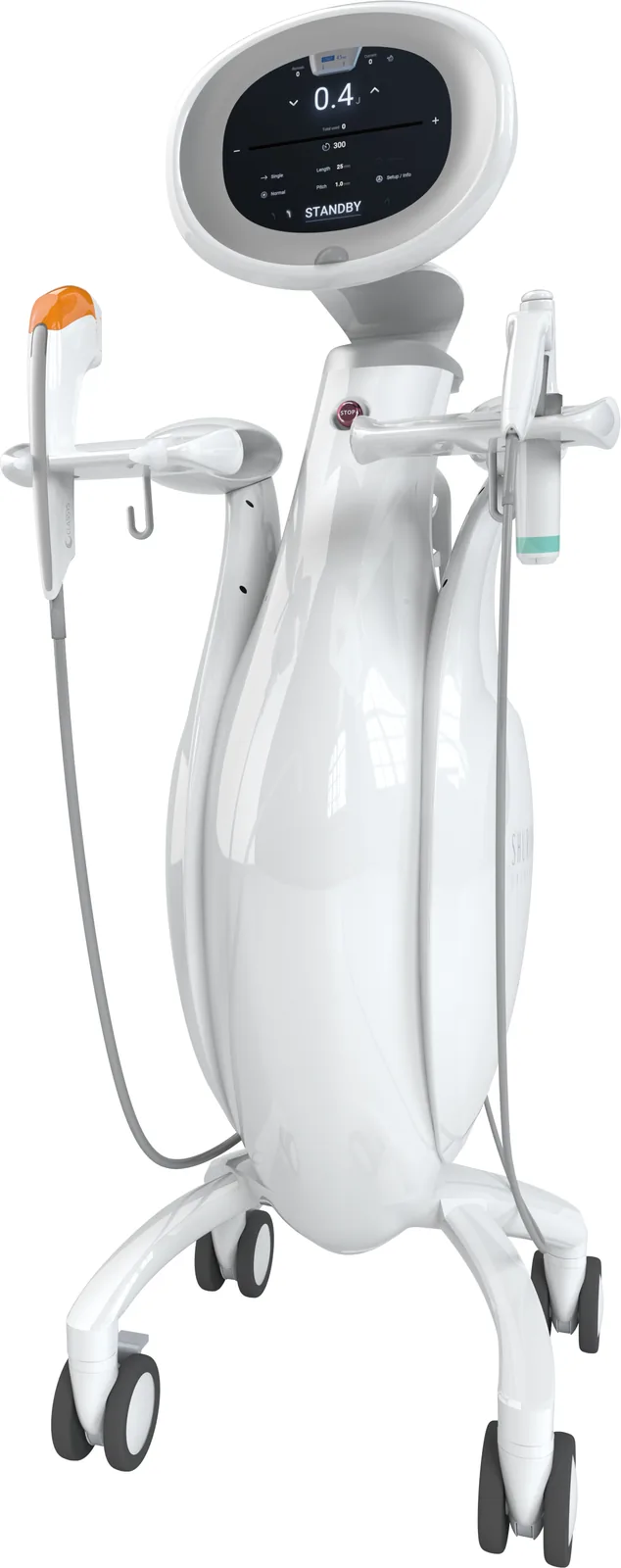
Neither family is a single product. Each holds an accessible platform and a premium one, so choosing a family is only half the decision.
Ultherapy Prime is micro-focused ultrasound with visualization. DeepSEE imaging puts the layers under the transducer on screen during the session and reads to 8 mm before a line is placed. Its focal depths are 1.5, 3.0 and 4.5 mm, the deepest reaching the SMAS, and sessions are billed in 100-shot increments.
Shurink Universe is focused ultrasound without live imaging, positioned here for entry and for maintenance between larger sessions. It is quoted by the 300-shot block, which keeps a first ultrasound session or a routine top-up within reach.
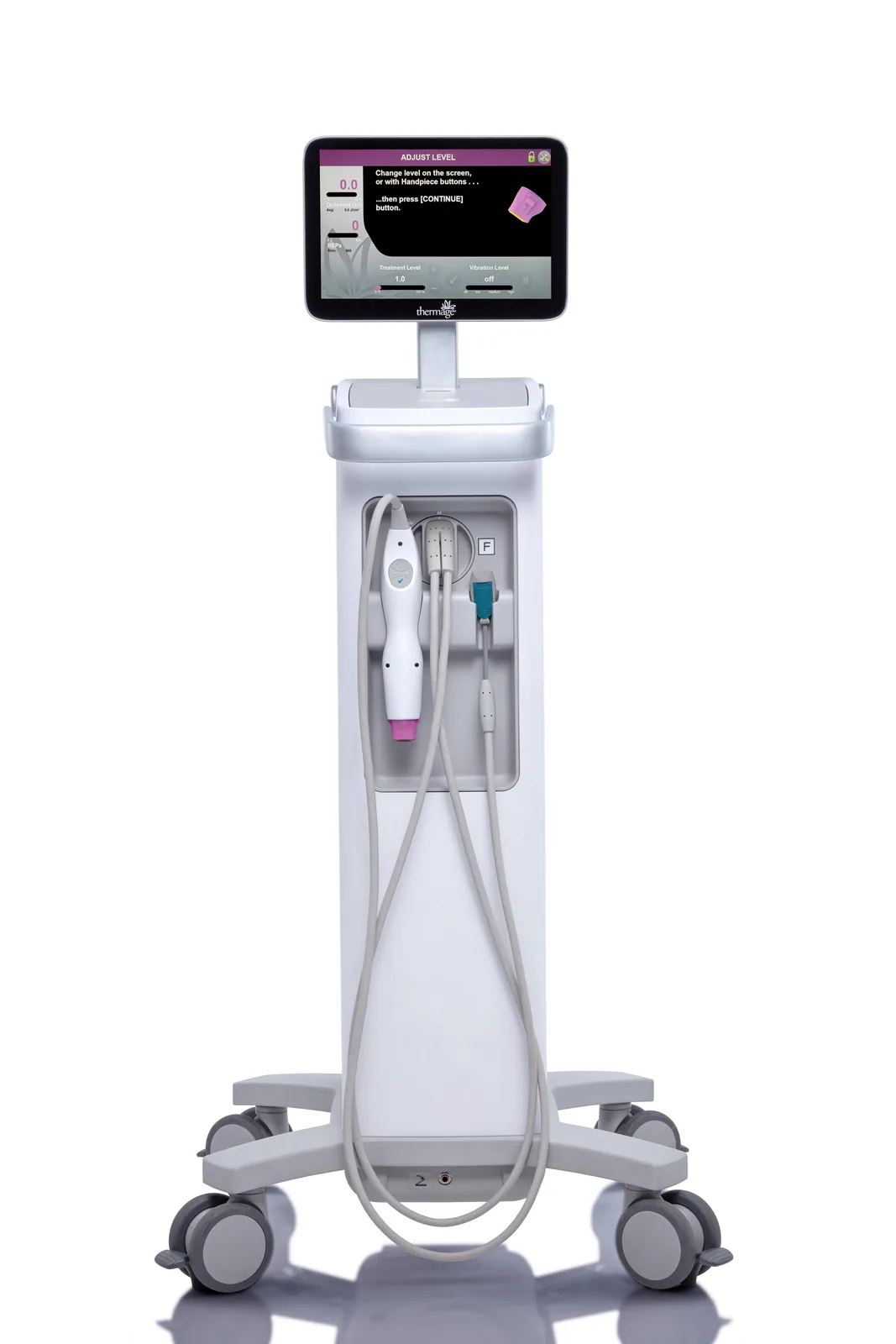
Thermage FLX is monopolar radiofrequency aimed at tightening and texture through the thickness of the skin. AccuREP calibrates every pulse to the tissue in front of it, and a full-face session runs through a single 600-shot tip, which is why it is priced as one session.
Density is high-density monopolar radiofrequency built around three tip grades — Classic, High and Alpha — each quoted per 300 shots at its own rate. That turns radiofrequency into something you can start gently and escalate.
So there are four answers on this floor. A reading that points at ultrasound still has to choose between imaging-guided precision and accessible upkeep, and one that points at radiofrequency still has to choose between a single calibrated tip and a three-grade escalation.
The two families as they are actually run here. On a phone the table slides sideways while the row labels hold their place.
| Focused ultrasound (HIFU) | Monopolar radiofrequency (RF) | |
|---|---|---|
| Platforms here | Ultherapy Prime, Shurink Universe | Thermage FLX, Density |
| How energy arrives | Sound waves converge on separate focal points | Current flows through a field and warms the volume inside it |
| What that does to tissue | Discrete points of coagulation on a planned line | Bulk heating across a treated zone |
| Depth selected by | The transducer cartridge — 1.5, 3.0 and 4.5 mm on Ultherapy Prime | Field geometry and surface cooling, across the thickness of skin |
| Layer usually addressed | Fibrous deep support, down to the SMAS on the deepest line | The dermis, broadly and evenly |
| Operator sees the layer | On Ultherapy Prime, yes — DeepSEE imaging to 8 mm | No imaging; calibration and cooling govern the pass |
| Billed in | Shots — 100-shot increments, or a 300-shot block | Tips and shot blocks — a 600-shot tip, or 300 shots per tip grade |
| Complaint it answers | Support that has loosened and contour that has descended | Skin that has gone slack and finely crepey across a whole area |
| Sensation, in principle | Brief deep pricks of heat, one per line placed | Waves of warmth with cooling between pulses |
| Recovery, in principle | Redness and warmth; tenderness along the treated lines | Redness and warmth; a tight feeling across the zone |
| Listed rate at Dear | ₩400,000 / 100 shots · ₩150,000 / 300 shots | ₩1,900,000 / 600-shot tip · ₩700,000 / 300 shots, entry tier |
| Used together | Yes — different depths, sequenced from one reading | Yes — sequenced, never stacked on the same spot |
The table describes the physics and the price card. Which row ends up on your chart is settled after the EVE Muse capture measures your skin thickness and locates the depth your slackness actually sits at.
A reading places you in one of four groups, and the fourth is the one worth reading carefully.
A jaw border blurring into the neck, a mid-face that has slid, heaviness gathering low by evening. Descent is a deep-support problem, and support is where converging sound can put energy without cooking the skin above it.
Fine crepe on the cheek, a surface that no longer springs back when pressed, looseness spread evenly with no single line dropped. A broad heated field matches a broadly distributed complaint.
Descended support and a slackened surface often arrive together, and one family cannot reach both. The families are then sequenced in an order your director writes, with the interval set at review.
Sensation follows the physics, not the badge on the console. Focused ultrasound concentrates energy into brief events at depth, so it is usually described as short, deep pricks of heat, each arriving as a line is placed and fading at once. Radiofrequency spreads energy over an area and over time, so it is usually described as building warmth with a cool interval between pulses. Neither description promises anything about your own tolerance.
Recovery follows the same logic. Neither family breaks the surface, so what people typically report afterwards is redness and warmth that settles, sometimes with tenderness where the deepest lines went or a tight feeling across a heated zone. Both are low-downtime treatments and neither is risk-free. Burns, a hollow where energy has been over-concentrated, and temporary numbness along a nerve branch are the failures both technologies share, and each is a question of depth, spacing and energy.
Timing is the other shared trait. Both families work by provoking tissue to remodel, so the visible part of the change accumulates in the weeks after a session instead of appearing as you leave. How long it holds varies with age, skin quality and how you live, and Dear Clinic publishes no fixed figure for it. Comfort measures are confirmed at your consultation.
Four of the eight lifting options in this building are on this page; XERF, Onda, New Titanium and thread lifting make up the rest. The capture is what narrows that list.
EVE Muse images the face in 3D under five light sources with AI analysis, mapping skin thickness zone by zone. A reading weighted toward deep descent argues for a focal line; one weighted toward surface slackness argues for a heated field. The measurement comes before any platform is named.
Both families are already installed and paid for here, so the recommendation is not steered by what needs using. That includes recommending the entry tier, or recommending that you leave without booking an energy session at all.
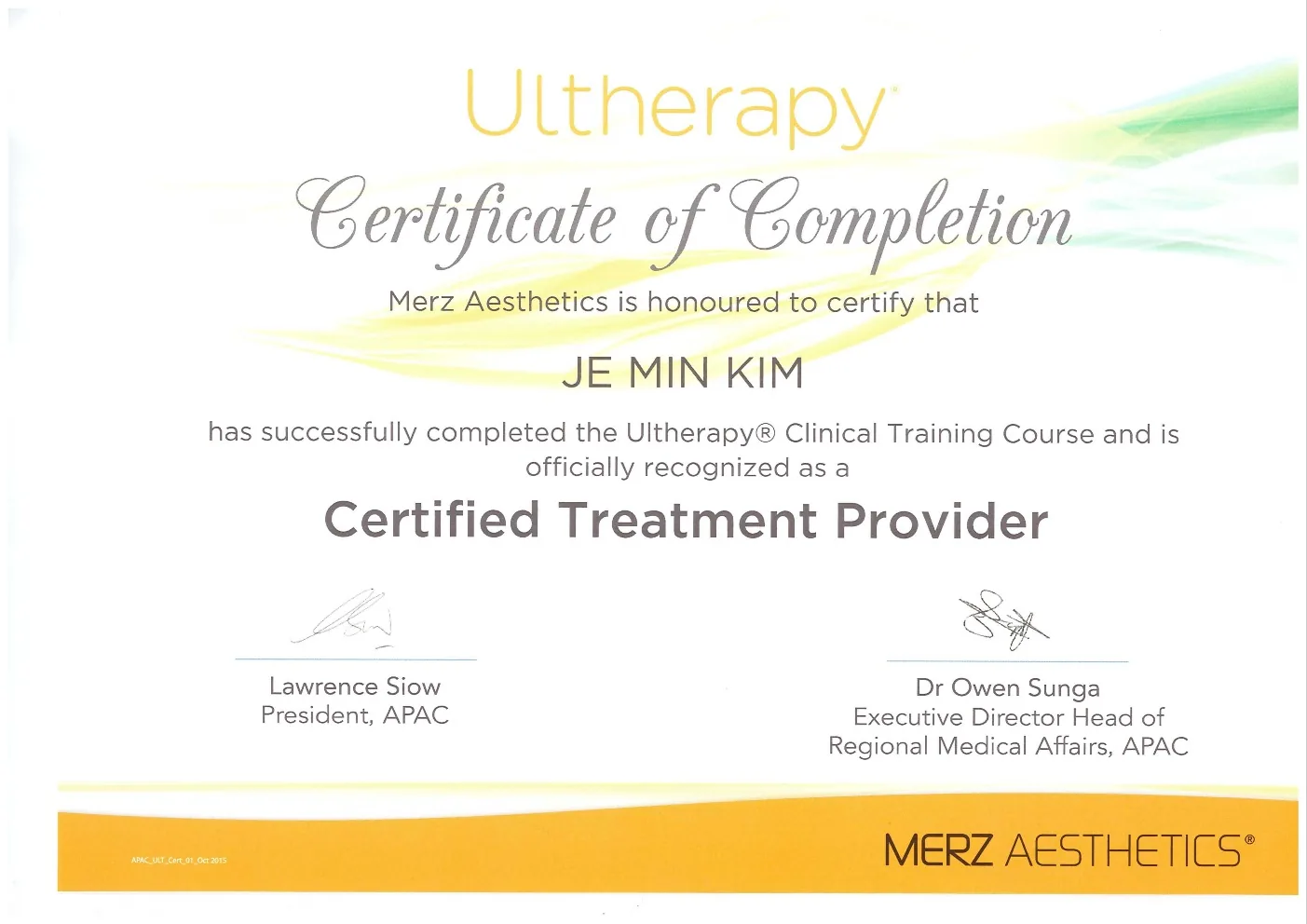
Dear holds Merz certification for Ultherapy under Dr. Jemin Kim and Dr. Seonhaeng Lee, and Thermage certification for three consecutive years. Every session here is director-performed, because a focal line placed at the wrong depth spends shots for nothing and a field held too long in one place can burn.
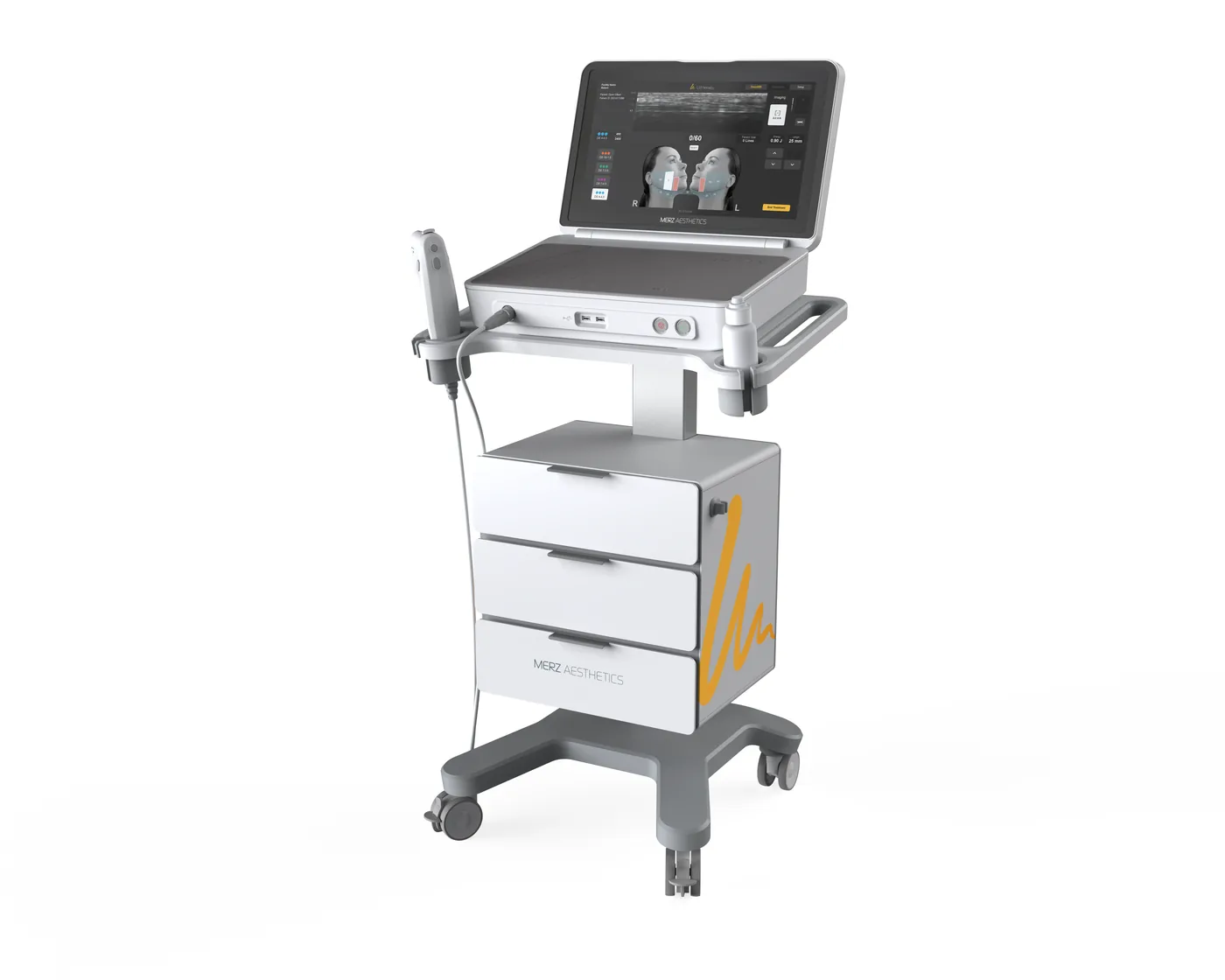
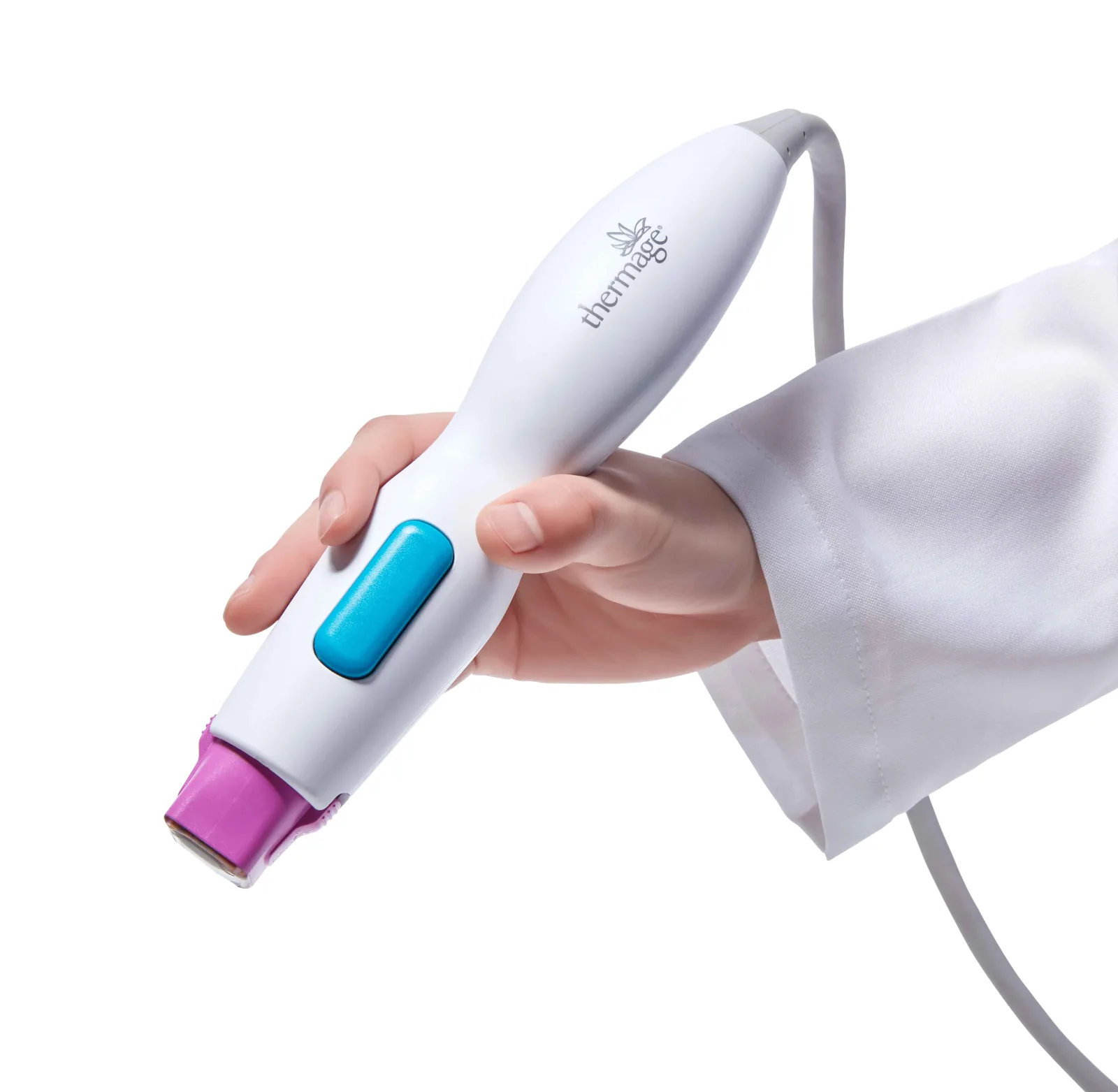
| Session | Unit it is sold in | Price |
|---|---|---|
| Ultherapy Prime | 100 shots; the shot count for a face is set from the capture | ₩400,000 (≈ $285) |
| Shurink Universe | 300 shots; the accessible ultrasound tier for a first session or upkeep | ₩150,000 (≈ $105) |
| Thermage FLX | One 600-shot tip, AccuREP calibrated, for a full-face session | ₩1,900,000 (≈ $1,355) |
| Density — Classic tip | 300 shots on the entry grade; the High and Alpha grades are quoted separately | ₩700,000 (≈ $500) |
One published card covers everybody, with the same figure whether you live in Gangnam or arrived last night. KRW is the amount that settles at the desk; the USD figure beside it is for reference. Your shot count, tip grade and total are approved at the consultation, and the full card is on the published price list.
The two technologies fail in the same ways, because both of them are heat delivered into living tissue.
Director-performed treatment is a Dear promise — your procedure is planned and performed by the doctors below.





Real verified reviews from our Google Business Profile.
4.9★★★★★ 310 Google ReviewsThe clinic was very professional from start to finish. Doctor Jung was excellent and gentle with the treatment. I felt well looked after and everyone was outstanding. Happy with my service!
I've visited clinic for LDM procedure. I don't speak Korean, so there was an interpreter who assisted me while consulting. The staff was very attentive, they asked me every time before applying products/covering my face during the procedure and it went smoothly. Planning to visit the clini…
All the staff are kind, the doctor is professional. They recommended us the treatment that fit us best and last the longest. A very nice experience overall.
I did a hydrofacial, white/black head removal, and 1 day lasers. Really kind staff and reasonable prices. The only thing I would advise is that your first consultation is with a salesperson and you don’t see the doctor until after you decide what you want and after you pay.
Had a great experience here as a foreigner! The doctors and staff were knowledgeable, friendly, and not pushy. They made recommendations in my consultation and were happy to work within my budget.
Describe what has changed and we will name the layer it is coming from. Answered in English as soon as possible.
Six indexed entries are listed below. Three concern focused ultrasound: a review of non-invasive ultrasound tightening techniques, a quantitative study of face and neck tightening with micro-focused ultrasound with visualization in Asian patients, and a prospective study of intense focused ultrasound on the neck and lower face. Three concern radiofrequency, including a randomised split-face trial that compared monopolar radiofrequency directly against micro-focused ultrasound with visualization.
Each is given as title, journal and year with a verifiable DOI. No outcome figure from any of them is reproduced here, and none of them predicts what either family will do in your own face.
References are provided for information — outcomes vary by individual and are assessed at your diagnosis. The last two describe fractional and microneedle delivery of radiofrequency, which are research contexts for the technology and not the monopolar platforms listed on this page.