

★★★★★
The clinic was very professional from start to finish. Doctor Jung was excellent and gentle with the treatment. I felt well looked after and everyone was outstanding. Happy with my service!
Brown on a face is a category, and the marks inside it behave so differently that one course cannot serve them all. What is offered here is a reading that names your pattern, then the line written for it.
The consequence is practical. Book a long course for what turns out to be a handful of discrete sun spots and you have bought a schedule you did not need; book one aggressive pass for a diffuse hormonal field and you have bought a rebound. Both mistakes start in the same place: a colour was treated as a diagnosis.
Faces also rarely carry one pattern. Freckles across a nose can sit over a field of older marks, and a cheek can hold brown plus a flush that reads as brown until a different light falls on it. The plan is written around that mixture.
One member of this family is handled apart. Melasma relapses, reacts to heat and punishes over-treatment, so it carries its own protocol and its own page — the melasma treatment route.
Four patterns account for most of what arrives described as pigmentation, and they are grouped here by how they behave.
Sharp-edged, scattered without symmetry, concentrated across cheekbones, temples and the bridge of the nose. They accumulate with years of exposure and do not fade between winters. Because each has an edge, they can be worked as individual lesions in one planned visit.
Small, warm-toned, clustered over the nose and upper cheeks, and visibly darker after a summer. They sit high in the skin, which is why they respond quickly, and they return with the next season of sun. The framing here is management and not erasure.
Flat brown or grey-brown shadows where acne, an ingrown hair or a reaction once sat. They carry no depression, so nothing here rebuilds tissue, and they fade on their own over months. The plan is about shortening that timeline without provoking more pigment.
Pink or purple-red traces after inflammation, plus fine vessels and diffuse facial redness. In a mirror they read as part of the same problem; under a vascular reading they separate cleanly. A pigment-directed pass leaves them untouched, so they go on the vascular line.
Two further findings are named at the scan and then sent off this page: slate or blue-grey pigment far below the others, a separate diagnosis, and anything asymmetric that has changed shape, colour or border, which goes for medical assessment first.
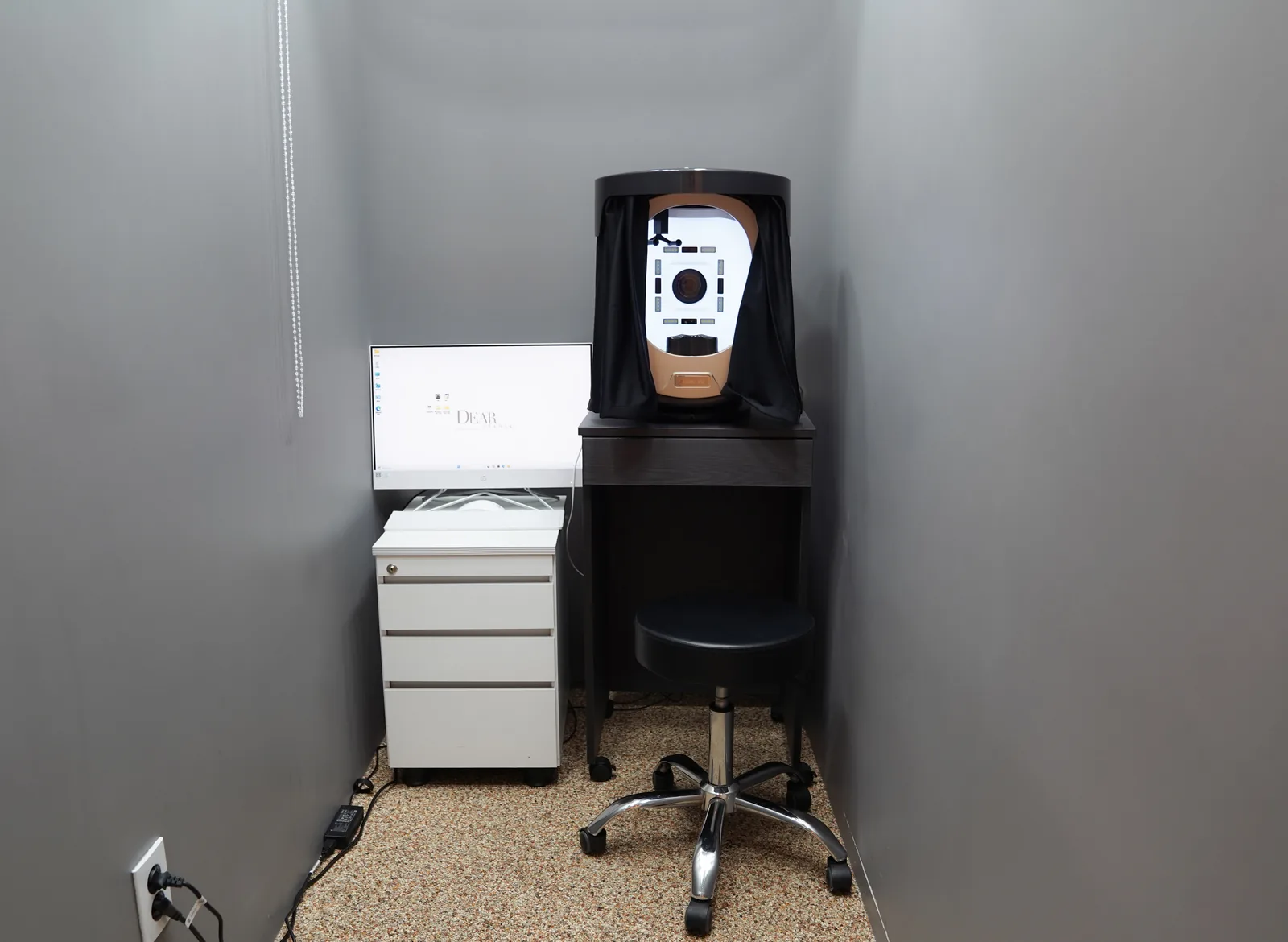
EVE Muse 3D imaging captures the face under five light sources with AI analysis. Light of different kinds reaches different distances into skin, so a field that looks uniform in daylight resolves into layers on screen. The mirror shows you the top of that stack.
Pigment sitting high answers sooner and holds its gain less well; pigment sitting deeper moves slowly and needs the schedule stretched. The reading assigns proportions to each, and those proportions are why two similar-looking cheeks leave with different plans.
Where the reading finds vessels or a standing flush under a mark, that component is priced on its own line and often treated first. Skipping this step is how someone finishes a pigment course and still sees colour.
The reading is also what makes it possible to decline politely: a face whose complaint turns out to be entirely post-inflammatory brown is told it will fade with time and sun discipline, and is offered the shortest plan here.
Four lines cover the pigment work in this building, each published and quoted on its own, so a plan using one is not billed as though it used three.
| Published line | What it is | The pattern it is written for | Listed rate |
|---|---|---|---|
| Dual Laser Toning · 1 session | A low-fluence 1064 nm Nd:YAG toning pass in a dual-wavelength session, with the in-clinic skincare step named on the same line | Diffuse, mixed-depth fields where restraint across repeat visits beats a single strong pass | ₩200,000 (≈ $145) |
| Triple Laser Toning · 1 session | The same session with a further laser step layered in, chosen at diagnosis | Fields the scan reads as more complex, or that showed limited movement on the dual configuration | ₩300,000 (≈ $215) |
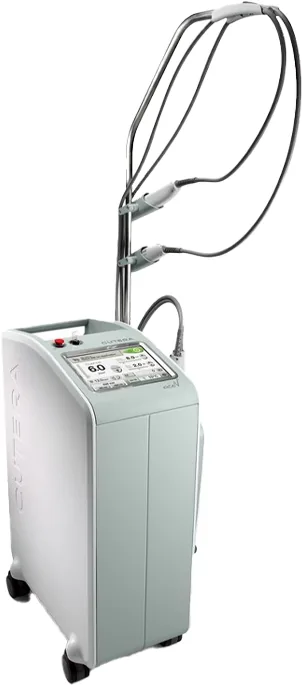
| Excel V | The Cutera 532/1064 nm vascular and pigment platform, quoted for the laser alone | Standing redness, fine vessels and the red marks that were never brown | ₩150,000 (≈ $105) |
| Dear Custom One-Day Laser | A single-visit plan assembled at the scan and stated in full before anything is switched on | A defined set of marks, or one trip to Seoul, where a repeating schedule is wrong | ₩400,000 (≈ $285) |
Figures current for September 2026 in KRW, with a USD equivalent shown for orientation only; a Seoul resident and a visitor are given the identical line. Toning is also published as a longer block, and that figure sits on the laser toning page. What a diagnosis visit and any later review cost is confirmed when you book. Everything published sits on the price list.
Marks with edges can be worked as a defined list inside one appointment, which is what the custom one-day plan exists for at ₩400,000 (≈ $285). The list is agreed and counted before the room is prepared, and freckles carry the caveat that next summer acts on them again.
Where the colour has no edge to grip, a single visit of dual toning at ₩200,000 (≈ $145) is trialled and judged, and the triple configuration at ₩300,000 (≈ $215) is held for fields the scan reads as more layered.
Anything the reading identifies as vascular goes to Excel V at ₩150,000 (≈ $105) for the laser, often first, so the brown can be judged without a red wash under it. Where both are present the two lines are sequenced and quoted side by side.
Post-inflammatory brown from acne usually starts upstream: while breakouts are still arriving each new lesion deposits a fresh mark, so the acne route or the Agnes line settles the inflammation first. Where the mark sits in a depression, the plan moves to acne scar treatment. The whole pigment corridor sits under laser skin treatments.

Melasma is not a mark that accumulated; it is a condition in which pigment-producing cells over-respond to triggers that stay in your life. Sunlight, visible light from a screen, heat, hormonal change and friction all provoke it, and each provocation restarts the deposition. Strip the output hard and the cells are handed one more reason to work.
It is therefore the one pattern here where a stronger setting is a worse setting. Histology work describes mottled hypopigmentation — pale dots where pigment cells have been pushed past what they tolerate — following low-fluence 1064 nm treatment for melasma, and a long-term follow-up study asks in its own title whether the route is effective over time. Both are listed at the foot of this page.
So a melasma field is offered restraint on purpose: conservative energy, intervals respected instead of compressed to fit a holiday, and a review that can stop the plan early. The target is a field that reads lighter and covers less ground, held there by maintenance and sun discipline. Everything specific to that condition sits on the melasma page.
The same restraint travels to deeper skin tones for a different reason: where melanin is abundant, absorbed light needs a lower setting and a slower pace, and an over-enthusiastic pass leaves a patch of altered tone that outlasts the mark it was aimed at.
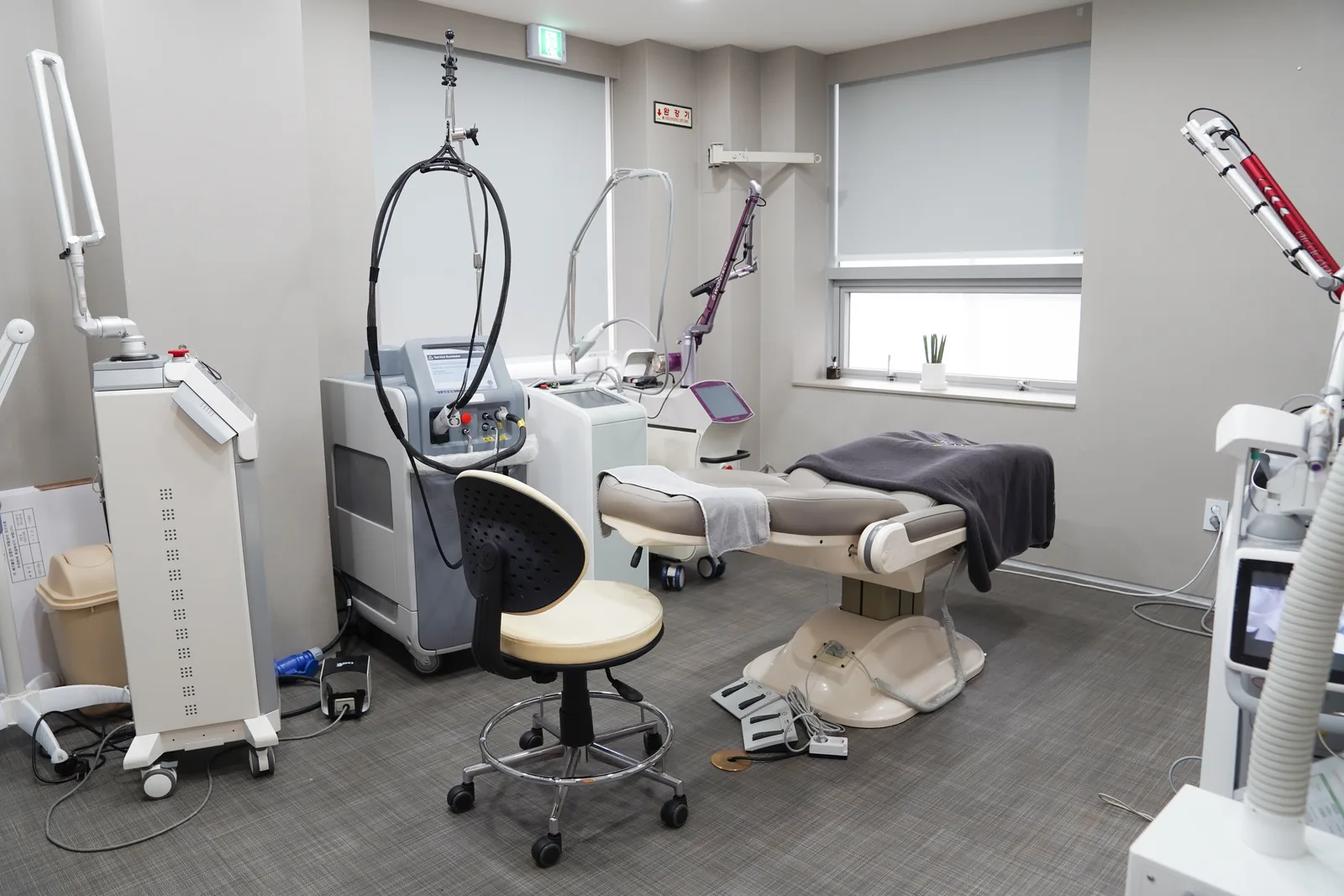
Toning, a 532/1064 nm vascular platform and a single-visit custom plan sit on this floor at published rates. A field with flush underneath goes to the vascular line even though the repeating toning schedule is the larger sale.
EVE Muse 3D imaging under five light sources with AI analysis establishes how much of your colour sits high, how much sits deep, and how much is not pigment at all. The quote follows that reading.
Sessions are director-performed. Fluence is dialled down between zones, an interval is stretched when the skin has not settled, and a booked visit is cancelled outright on irritated, peeling or freshly sun-exposed skin.
We decline pigment bookings more often than people expect, and the commonest refusal is a recent holiday. Where the reading shows deeper slate pigment, we do not recommend a toning schedule and say so at the scan. The named risks are transient redness and warmth, short-lived swelling, crusting over individually worked spots, post-inflammatory pigment if the skin is irritated afterwards, mottled hypopigmentation where low-fluence work has been pushed too hard, and rebound darkening after over-treatment. What is done for comfort during a session is confirmed with you at consultation. Outcomes vary between individuals.
Director-performed treatment is a Dear promise — your procedure is planned and performed by the doctors below.





Real verified reviews from our Google Business Profile.
4.9★★★★★ 310 Google ReviewsThe clinic was very professional from start to finish. Doctor Jung was excellent and gentle with the treatment. I felt well looked after and everyone was outstanding. Happy with my service!
I've visited clinic for LDM procedure. I don't speak Korean, so there was an interpreter who assisted me while consulting. The staff was very attentive, they asked me every time before applying products/covering my face during the procedure and it went smoothly. Planning to visit the clini…
All the staff are kind, the doctor is professional. They recommended us the treatment that fit us best and last the longest. A very nice experience overall.
I did a hydrofacial, white/black head removal, and 1 day lasers. Really kind staff and reasonable prices. The only thing I would advise is that your first consultation is with a salesperson and you don’t see the doctor until after you decide what you want and after you pay.
Had a great experience here as a foreigner! The doctors and staff were knowledgeable, friendly, and not pushy. They made recommendations in my consultation and were happy to work within my budget.
Your questions, answered in English as soon as possible.
Two claims here rest on the studies below: that diffuse pigment is managed with restraint, and that red components belong on a vascular platform. Three papers concern low-fluence 1064 nm Nd:YAG treatment for melasma — a histology study of mottled hypopigmentation after it, a long-term follow-up asking whether the route is effective, and a comparison against another light-based route. The rest test 532 nm work on facial vessels and spider nevi in split-face and controlled designs. Each reports outcomes across courses, which is why a range is discussed at your scan.
References are provided for information — outcomes vary by individual and are assessed at your diagnosis.