Home
Doctors Pricing Cost FAQ Book a Consultation
ENES
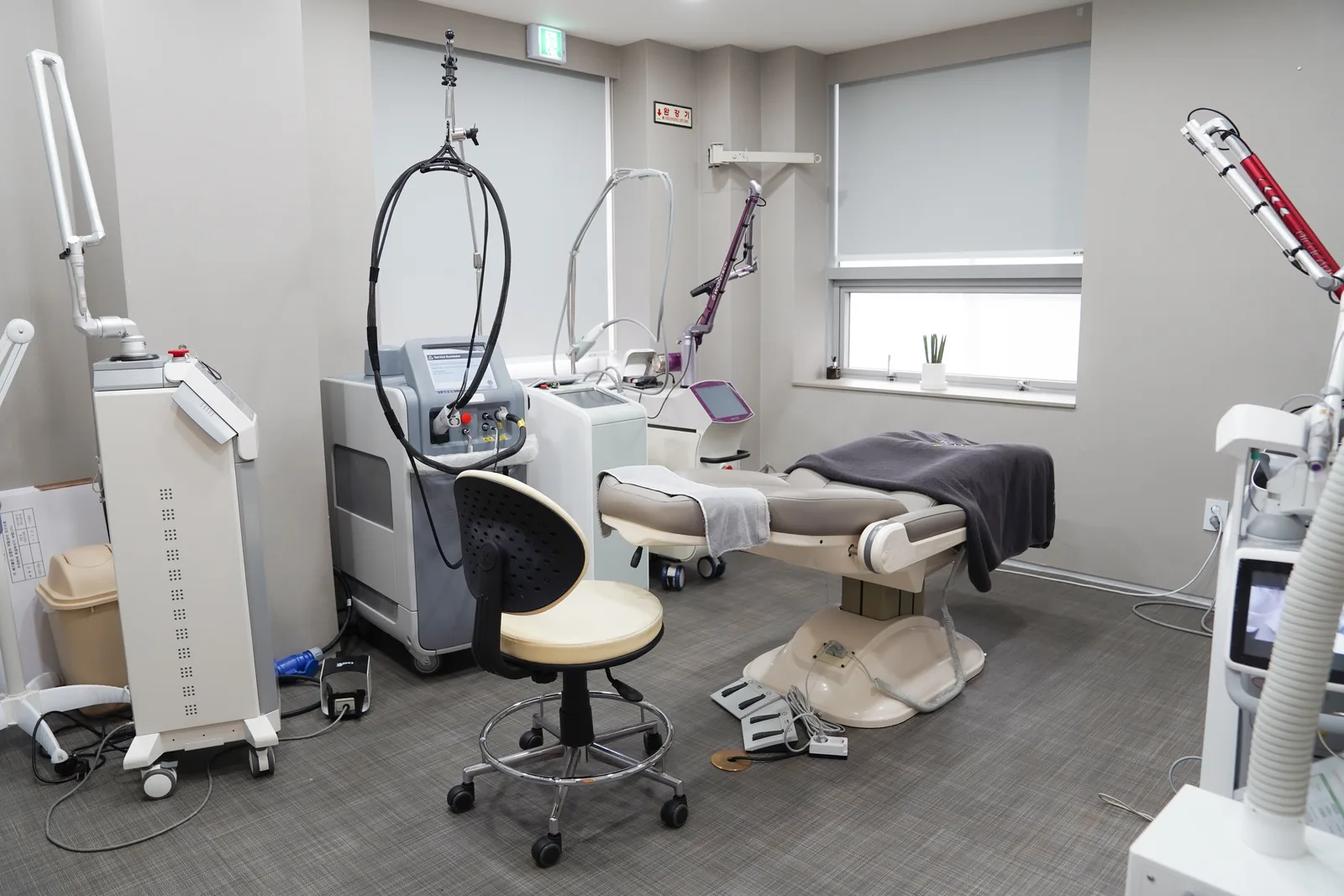
Laser treatment room at Dear Clinic Cheongdam with several laser platforms and a powered treatment couch
Dear Clinic · Energy Comparison · Skin
Microneedling vs laser in Cheongdam, Gangnam, Seoul

Laser vs Microneedling

A laser beam has to be absorbed by something coloured or wet before it can do any work. A microneedle carrying radiofrequency ignores colour completely and puts its heat at a depth the doctor dials in. That difference is why one family is quoted for pigment and vessels and the other for scars, pores and slack texture.

Light absorbed by a target · RF placed at a depth Five published lines across both families Open 365 days
Ask Which Family Fits See Both Rates
Direct Answer

One family chases a colour, the other chases a depth

Laser energy is light, and light only becomes heat where something absorbs it: brown pigment, the red of a vessel, or the water in tissue. Microneedling here means radiofrequency carried down fine needles, which is indifferent to what colour your skin is and delivers its heat at whatever depth the handpiece is set to. Aiming at a target is a different job from aiming at a level, and the two families are quoted for different complaints because of it.

Put crudely: a problem you can point at and name a colour for — freckling, a patch of melasma, a vessel across the nostril rim — belongs to the light side of the floor. A problem with a shape and no colour — an ice-pick scar, an open pore, a grain that has loosened — gives light nothing to grip, and needles are how the energy reaches the level where the collagen sits.

The second consequence matters more for deeper skin tones. Because melanin absorbs light, a laser pass carries a pigment risk that rises with how much melanin is in the beam's way, while radiofrequency carries no such bias. Five lines are published here across the two families, and the EVE Muse 3D capture decides which of them your chart gets.

The Two Families

Three light routes, two needle routes

Every line named here is run in this building.

LIGHT 01

Dual Laser Toning — low fluence, repeated

Low-fluence 1064 nm neodymium toning, run as a dual-wavelength session with in-clinic skincare. The energy per pass is deliberately small; the technique works by repetition across a course, and it is the route taken where pigment is diffuse instead of spotted.

LIGHT 02

Excel V — two wavelengths, one chromophore each

The Cutera platform delivers 532 nm and 1064 nm. The shorter wavelength is aimed at surface redness and discrete brown marks; the longer one reaches vessels sitting deeper. This is the laser quoted when a patient can point at something and name its colour.

LIGHT 03

CO2 and erbium — charged one lesion at a time

These wavelengths are absorbed by water, so they act on the tissue itself. They are used here on individual lesions and billed that way — the only line on this page whose price follows a count of marks.

Needle route 01 — Potenza with the standard tip

Microneedles pass through the surface and deposit radiofrequency at a set depth. Potenza has several tip types (insulated, non-insulated, semi-insulated and pumping), and the director chooses the tip for your skin’s condition; the heat lands where atrophic scarring and loosened texture sit. Depth and energy are reset at every zone boundary. Published clinical work stands behind this line for atrophic acne scarring and for enlarged pores, including a series carried out in Asian skin.

Needle route 02 — pumping tip with a 5 cc booster

The same platform with the pumping tip, which drives a booster into the channels the needles open. The published unit pairs the session with 5 cc of a PDLLA-and-hyaluronic-acid hybrid or an exosome preparation, and it carries its own figure on the card.
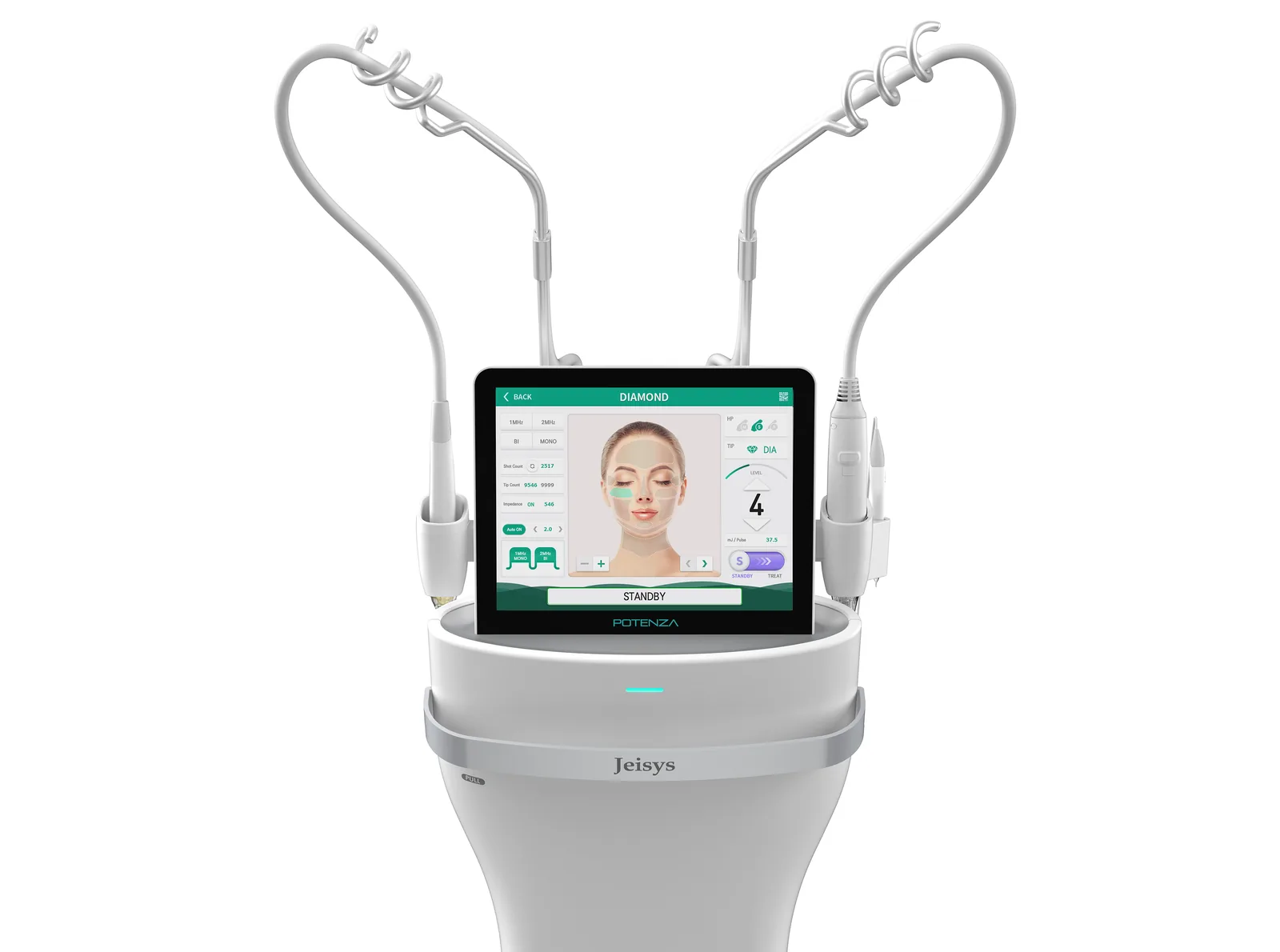
Jeisys Potenza RF microneedling system with both handpieces and its touchscreen showing the treatment menu
The radiofrequency microneedling platform with both handpieces — standard tip and pumping tip on the same console.
Side by Side

Light energy and needle radiofrequency, row by row

Two ways of getting energy into skin, read row by row. On a phone the table slides sideways while the labels hold.

 Laser & light routesRF microneedling
Energy carried byLight at a chosen wavelengthRadiofrequency down fine needles
What it aims atA chromophore — melanin, haemoglobin or waterA depth, set on the handpiece
Affected by skin toneYes — melanin competes for the beamNo — radiofrequency does not read colour
Surface crossedBeam passes through, or removes it in the ablative casePierced at fine points; the director chooses the tip type for your skin
Best answersFreckling, melasma, sun damage, redness and vessels, individual raised lesionsAtrophic acne scars, enlarged pores, loosened texture, early laxity
Will not solveDepressed scars and open pores — there is no colour to absorb the beamPigment and vascular marks — heat at depth does not clear a brown patch
Recovery signatureFlush and warmth on the toning and vascular routes; a crust over each treated spot on the ablative routeA grid of pinpoint marks with swelling, settling over days
Unit chargedPer session, or per lesion for CO2 and erbiumPer session, tip dependent
Listed ratesToning ₩200,000 · Excel V ₩150,000 · per lesion ₩10,000Standard ₩250,000 · pumping with 5 cc ₩500,000
Course shapeToning is built as a repeated course; vascular and ablative work is counted by targetSpaced sessions, reassessed at each visit
Used togetherYes — sequenced across visitsYes — never in the same pass over the same skin

The table describes the families. Which line goes on your chart is settled after the capture, and results vary by individual regardless of which side of the table you end up on.

Case by Case

Which complaint goes to light, and which to needles

Three readings cover most consultations that begin with this comparison, and the capture places you in one of them.

LEANS LIGHT

You can point at it and name its colour

Brown patches that darken through the summer, a flush that has stopped settling, a vessel drawn across the nostril rim, a raised mark you keep catching with a razor. Each has something for a beam to be absorbed by, and the wavelength follows what the capture shows.

LEANS NEEDLE RF

You can feel it in raking light, not in colour

Boxcar and ice-pick scars left by an adolescent year, pores that read as small craters in side light, skin that has lost its grain. Nothing here absorbs light preferentially, so the energy has to be carried down to the level where the collagen is.

LEANS BOTH

Scarring with pigment sitting on top of it

A common reading, and the one most often mis-sold as a single miracle session. Post-inflammatory marks and textural scarring are two problems in one photograph, sequenced across separate visits.

01
Pigment & sun damage (light)
02
Redness & vessels (light)
03
Scars & pores (needle RF)
04
Sequenced across visits
Recovery

Downtime is different in kind, not only in length

Asking which family has less downtime is the wrong shape of question, because the two leave different things behind. A low-fluence toning pass leaves warmth and a flush, which is a colour problem. A needle array leaves a fine grid of puncture points with swelling, which is a texture problem. An ablative spot leaves a crust. Which of those you can live with next Tuesday depends on your diary.

Principles hold better than numbers, and no fixed recovery figure is published for either family because individual healing varies too widely to promise one. The working rules: the more the surface is disturbed, the more absolute sun protection has to be; a crust is left alone until it separates by itself; open channels stay away from makeup, pools and gyms for the window your director specifies.

The risks are named in advance because they are real on both sides. On the light side: post-inflammatory darkening, and on repeated low-fluence courses the published concern is the opposite — mottled hypopigmentation, which is why energy is dialled down and a visit is skipped when the skin says so. Burns and blistering sit at the rare end. On the needle side: swelling, pinpoint marks, temporary roughness, and infection if aftercare is ignored. Here our directors read the capture and deliver every pass themselves, setting depth, energy and spacing from what the skin is doing on the day.

Sequencing

Running light and needles in the same plan

A face with scarring under pigment needs both families eventually, and the published split-face work comparing fractional ablative laser with needle radiofrequency exists precisely because the two are genuine alternatives for part of that job. What no evidence supports is stacking them over the same skin in one pass, and that is not done here.
One capture plans both halves, so the sequence is designed once instead of being improvised visit by visit
Pigment work and needle work are separated in time over the same zone, with the interval written by your director
Where the reading names only one problem, only one family is quoted — a second line is not added to round out a plan
Pricing

What each laser and microneedling line
is charged at in Cheongdam

Five published lines sit across the two families. A dual toning session with in-clinic skincare is ₩200,000 (≈ $145); an Excel V session, laser only, is ₩150,000 (≈ $105); CO2 and erbium work is ₩10,000 (≈ $5) per lesion. On the needle side a standard-tip session is ₩250,000 (≈ $180) and the pumping tip with 5 cc of booster is ₩500,000 (≈ $355). Korean residents and international visitors are quoted from the same card.
LineFamilyUnitListed rate
Dual Laser Toning + skincareLight — low fluence 1064 nmOne session₩200,000 (≈ $145)
Excel VLight — 532 / 1064 nm vascular and pigmentLaser only, skincare not included₩150,000 (≈ $105)
CO2 / erbiumLight — absorbed by waterPer lesion₩10,000 (≈ $5)
Potenza, standard tipNeedle RFOne session₩250,000 (≈ $180)
Potenza, pumping tip + 5 ccNeedle RF with boosterOne session₩500,000 (≈ $355)

Published rates as of September 2026. We do not publish a session count for either family, because the number depends on what the capture finds and how your skin answers the first visit. Your written plan is agreed before any handpiece is switched on, and what a consultation or a review visit is charged at is confirmed with you at that consultation.
In the clinic

The devices and hands behind this treatment

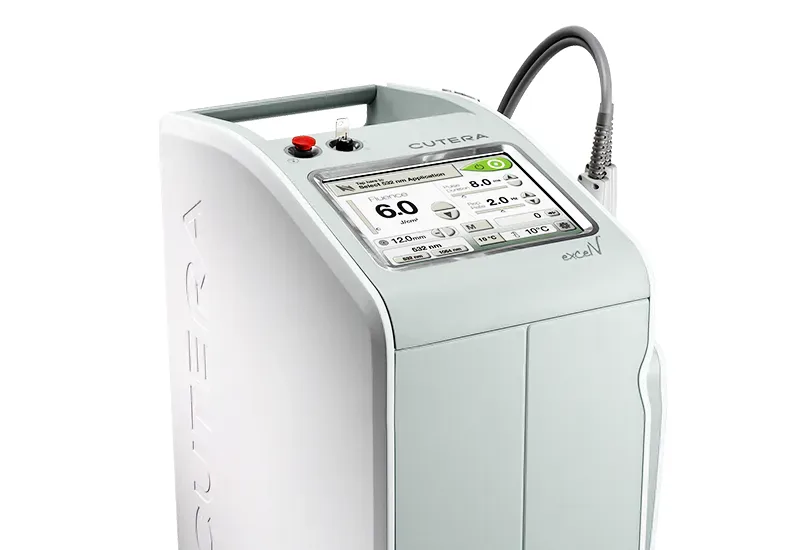
Cutera excel V vascular laser console with its touchscreen and delivery fibre
The vascular and pigment laser, with the wavelength chosen from the capture
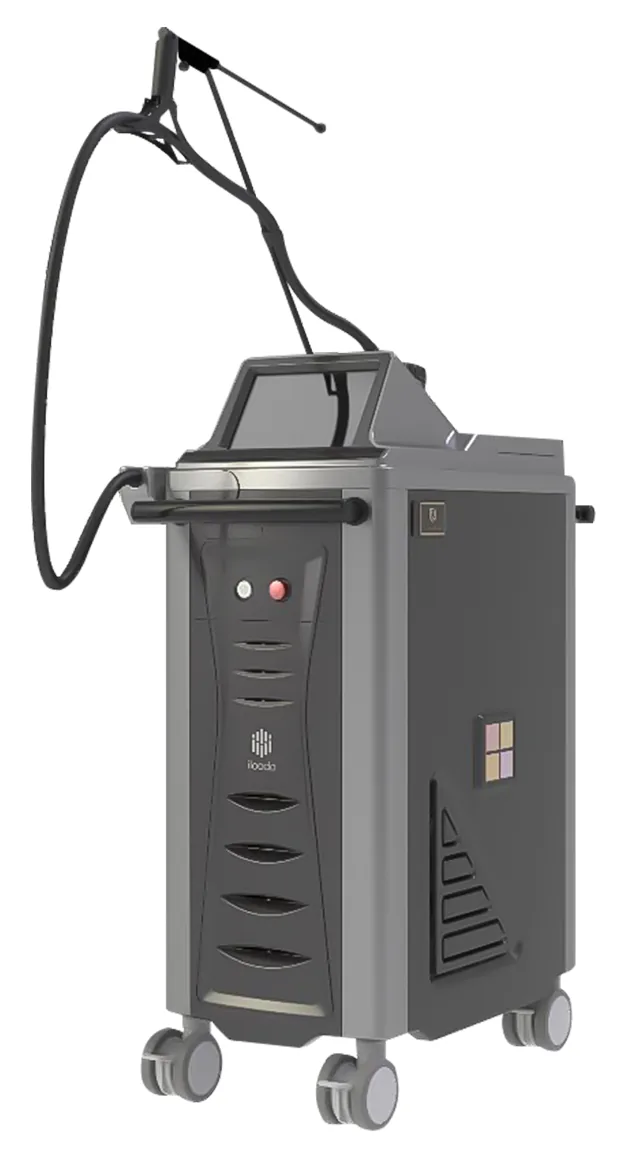
New Titanium (Portra Quattro) lifting laser platform on castors with its articulated delivery arm and handpiece at Dear Clinic
A laser platform in the laser room at Dear Clinic
Aesthetic care room with an LED panel and hydro-peel unit at Dear Clinic Cheongdam
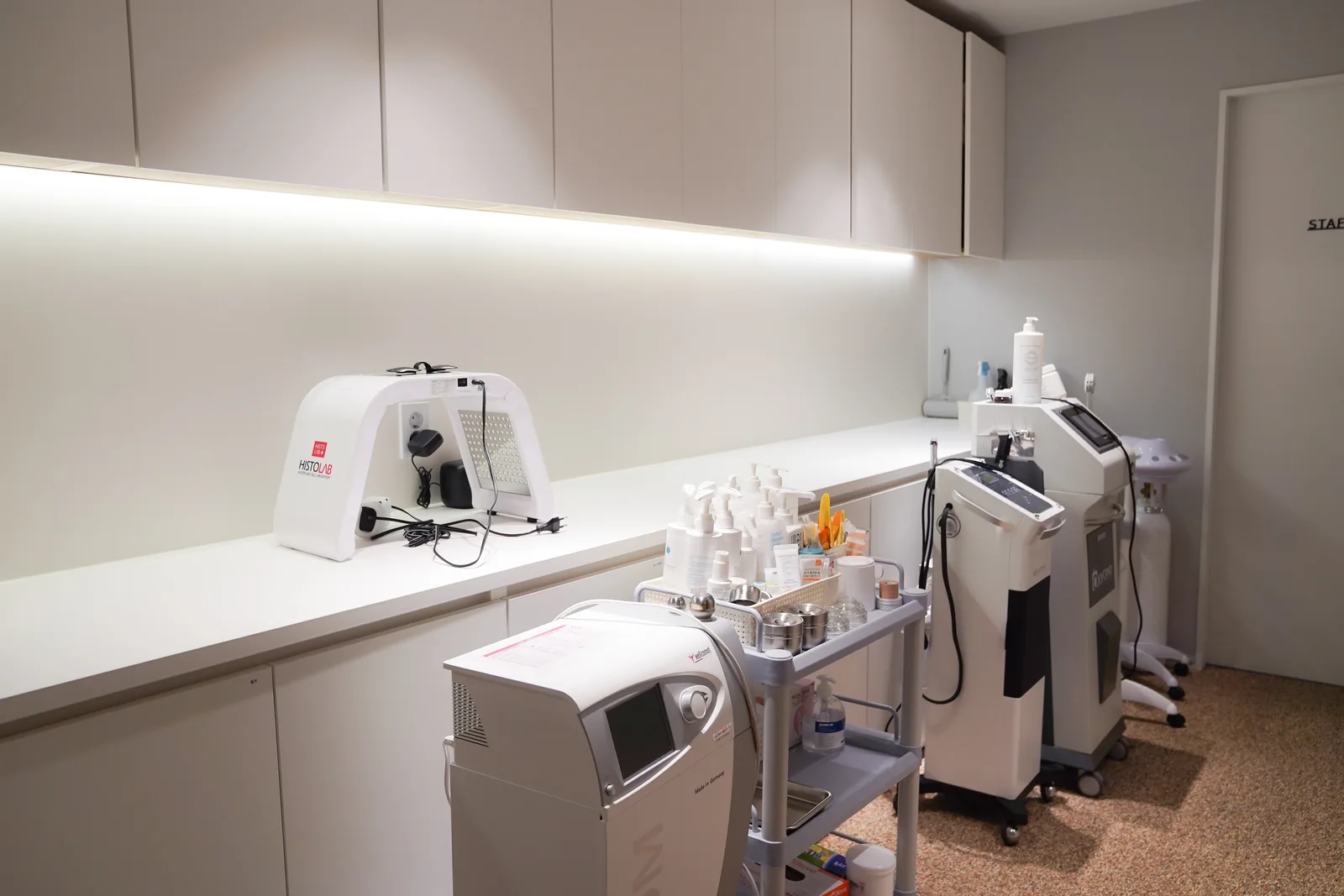
The care room where in-clinic skincare follows a toning session
When We Say No

Energy appointments that end with neither family booked

Named in advance, because each of these costs money and skin if it is found afterwards.

Acne is actively inflamed inside the field. Energy over live lesions invites post-inflammatory marking, so the acne is addressed first.
The capture reads descent rather than texture. Neither family repositions tissue, and we do not recommend a scar or pigment line as a substitute for a lifting conversation.
A toning course has been run hard already and the skin shows patchy lightening. More passes make mottled hypopigmentation likelier, so the course stops.
You are tanned, mid-flare or on a medication that raises photosensitivity. Light routes are postponed until that resolves, and the reason goes on your chart.
You want one session before a flight tomorrow. Where every option for your reading leaves something visible, we will say so and let you move the date.
Caution

The week after a laser pass or a needle session

Sun protection is not optional on either side; a treated area that catches sun while healing is the fastest route to the pigment problem you came in to fix.
Leave any crust from an ablative spot completely alone until it separates on its own.
Keep makeup, pools, saunas and hard training out of the diary while needle channels are still closing.
Acids, retinoids and scrubs stay out of the routine until your director clears them at review.
Call the clinic about spreading redness, pus, blistering or any new pale patch, on either side of the floor.
Medical Team

Five doctors, one standard

Director-performed treatment is a Dear promise — your procedure is planned and performed by the doctors below.


Dr. Jemin Kim — Medical Director and Founder, Dear Clinic
Dr. Jemin Kim
Yonsei University College of Medicine
Medical Director · Founder
Dr. Sanghyun Lee — Director, Dear Clinic
Dr. Sanghyun Lee
Seoul National University College of Medicine
Director
Board-certified · Family Medicine
Dr. Seonhaeng Lee — Director of Aesthetic Medicine, Dear Clinic
Dr. Seonhaeng Lee
Chosun University College of Medicine · Residency, Samsung Medical Center
Director, Aesthetic Medicine
Dr. Daeun Jung — Director, Dear Clinic
Dr. Daeun Jung
Ajou University College of Medicine
Director
Board-certified · Family Medicine
Dr. Woojae Jung — Director of Aesthetic Medicine, Dear Clinic
Dr. Woojae Jung
Seoul National University — B.S. in Medicine
Director, Aesthetic Medicine
Patient Reviews

What our patients say

Real verified reviews from our Google Business Profile.

4.9★★★★★ 310 Google Reviews
FAQ

Light against needles, question by question

How does microneedling compare to laser for acne scars and pores?
For depressed scars and open pores, needle radiofrequency has the most direct claim: the problem is a shape at a depth, and the array puts energy exactly there. Published split-face work has compared fractional ablative laser against needle radiofrequency for scarring, so both sit in the conversation. Pigment left by the same acne is a separate job for the light side.
Which has less downtime, microneedling or laser in Cheongdam?
They leave different things behind, so the comparison depends on what you can tolerate. Low-fluence toning leaves warmth and a flush. Needle radiofrequency leaves a grid of pinpoint marks with swelling. Ablative spots leave a crust. No fixed recovery figure is published, because individual healing varies too widely to promise one.
Is radiofrequency microneedling actually a laser?
No. A laser emits light at one wavelength and needs a chromophore to absorb it. Radiofrequency is an electrical current delivered through needles, heating tissue by resistance at the depth the needles reach. Different physics, different targets, different shortlist.
Does my skin tone change which family you use?
It changes the light side considerably. Melanin absorbs light, so a deeper tone competes for the beam and raises the pigment risk, which is why wavelength, fluence and interval are adjusted and why some light routes are declined. Needle radiofrequency is unaffected by tone, which often makes it the safer opening move.
Can laser and microneedling be done on the same day?
Not over the same skin in one visit. Two energy families stacked across one field multiply the heat load and make it impossible to tell which produced which result. Where both are genuinely needed, they are separated in time and the interval is written by your director.
Will laser toning clear my melasma for good?
No. Melasma is chronic and relapsing; low-fluence toning is a management route run as a course, and the published long-term work is openly mixed about how durable it is. Repeated aggressive toning carries its own risk of patchy lightening, which is why the energy is kept deliberately low here.
What is the pumping tip, and why is it a separate rate?
A different handpiece on the same platform. It drives a 5 cc booster into the channels the needles open, so one session covers texture and skin quality together, and the booster volume is why it appears on the card as its own line at ₩500,000.
Why is CO2 and erbium work charged per lesion instead of per session?
Because that is how the technique is used here. These wavelengths are absorbed by water and act on the tissue of an individual mark, so the work is counted by target and billed at ₩10,000 a lesion. A face with one raised mark and a face with fifteen are not the same treatment.
How many sessions should I plan for?
No number is published for either family, because it depends on what the capture finds and on how your skin answers the first visit. Toning is designed as a repeated course by nature; needle sessions are spaced and reassessed each time. Your director gives a working range at the consultation and revises it at review.
Which family is better for large pores specifically?
Needle radiofrequency, and there is retrospective clinical work behind that indication. A pore is a structural opening with no colour to absorb light, so a pigment laser has nothing to act on. What a laser can do alongside is reduce the surrounding discolouration that makes pores read larger.
Can I have the scan and a first session on the same day?
Usually, once the capture has been read and the plan approved in writing. Both families are on the floor here and the clinic opens 365 days a year, holidays included, so a first visit can follow the consultation where suitability is confirmed. Photosensitive skin or an active flare will delay the light routes.
Do visitors from abroad pay different rates for these lines?
No. One card covers everyone: ₩200,000 for a dual toning session, ₩150,000 for Excel V and ₩250,000 for a standard-tip needle session, whether you live in Seoul or arrive for a week. Tell us your departure date at the consultation, because it legitimately affects which family is recommended.
Consultation

Describe the mark, and we will name the energy

Tell us whether you can see it or only feel it, and send your dates. A written answer comes back in English as soon as possible.

Scientific Evidence

Published work across needle radiofrequency and low-fluence light

Six papers, four on the needle side and two on the light side. The radiofrequency group covers a direct split-face comparison against fractional ablative laser for scarring, an atrophic acne scar series in Asian skin, a retrospective study on enlarged pores, and a meta-analysis of fractional radiofrequency for acne and scarring. The two low-fluence papers appear here deliberately for their limits: one reports long-term outcomes and asks whether the technique holds up, the other examines mottled hypopigmentation after repeated treatment.

They are listed with DOIs so the primary sources can be read in full. None of them prices a treatment, chooses a family for your face, or predicts what your own skin will do.

  1. Hendel K et al. Fractional CO2‐laser versus microneedle radiofrequency for acne scars: A randomized, single treatment, split‐face trial. Lasers in Surgery and Medicine. 2023. doi:10.1002/lsm.23655
  2. Vejjabhinanta V et al. The efficacy in treatment of facial atrophic acne scars in Asians with a fractional radiofrequency microneedle system. Journal of the European Academy of Dermatology and Venereology. 2013. doi:10.1111/jdv.12267
  3. Ren K et al. Fractional microneedle radiofrequency treatment for enlarged facial pores: A real‐world retrospective observational study on 75 patients. Journal of Cosmetic Dermatology. 2022. doi:10.1111/jocd.15339
  4. Li J et al. Meta‐analysis of fractional radiofrequency treatment for acne and/or acne scars. Journal of Cosmetic Dermatology. 2022. doi:10.1111/jocd.15348
  5. Gokalp H et al. Long‐term results in low‐fluence 1064‐nm Q‐Switched Nd:YAG laser for melasma: Is it effective? Journal of Cosmetic Dermatology. 2016. doi:10.1111/jocd.12253
  6. Jang YH et al. Changes in Melanin and Melanocytes in Mottled Hypopigmentation after Low-Fluence 1,064-nm Q-Switched Nd:YAG Laser Treatment for Melasma. Annals of Dermatology. 2015. doi:10.5021/ad.2015.27.3.340

References are provided for information — outcomes vary by individual and are assessed at your diagnosis.

Book WhatsApp Call