Home
Doctors Pricing Compare FAQ Book a Consultation
ENES
Reception desk at Dear Clinic in Cheongdam, Gangnam, Seoul, with the backlit DEAR sign on a curved plaster wall
Dear Clinic · Compare · Juvederm vs Restylane
Two Imported HA Families

Juvederm vs Restylane in Korea

Dear Clinic stocks both, so this comparison decides nothing on stock. They are two hyaluronic acid families with different cross-linking and different gel behaviour, published at ₩400,000 and ₩350,000 per cc, and the area you are treating is what should pick between them.

Both families in stock Priced per cc Open 365 days
Book a Consultation See The Comparison
The Short Answer

What is the difference between Juvederm and Restylane?

Both are cross-linked hyaluronic acid, and both are injected into the same anatomical planes. They differ in how each manufacturer builds the gel, which changes how firm it feels, how it spreads through tissue and how it holds shape under load. Neither family is the stronger product; they are two different property sets, and the area decides which set is wanted.

Juvederm is made by AbbVie/Allergan and Restylane by Galderma. Each name covers a range, not a single syringe, and within each range the gels are built at different firmness levels for different jobs. Comparing the two brand names alone is therefore a coarse comparison: the useful question at a consultation is which specific gel, at which depth, in which quantity.

That is why Dear Clinic quotes both families on the published card at ₩400,000 (≈ $285) and ₩350,000 (≈ $250) per cc, alongside the Korean house family at ₩130,000 (≈ $95) per cc. Your director recommends from the reading, and the gel that is opened is the one the design calls for.

Side by Side

Juvederm and Restylane, property by property

Read the third row first. Gel structure is what makes the rest of the column follow.

 JuvedermRestylane
ManufacturerAbbVie/AllerganGalderma
MaterialCross-linked hyaluronic acid, a gel that binds water and integrates with your own tissueCross-linked hyaluronic acid, the same base material with a different manufacturing route
Gel structureDescribed by its maker as a smooth, cohesive gel — it tends to flow as one mass through the plane it is placed inDescribed by its maker as a gel with a particulate structure — it tends to stay where it is put and resist deformation
What that changes in practiceBlending across a broad surface and finishing a soft contourHolding a defined edge or projecting a structure that carries load
Planes used at DearDeep, Mid and Superficial, chosen per areaDeep, Mid and Superficial, chosen per area
Planning precisionWritten to 0.1 ccWritten to 0.1 cc
ReversibleYes — hyaluronic acid responds to a hyaluronidase enzyme injectionYes — the same enzyme applies
Typical downtimeEntry-point bruising and short-lived swelling; lips swell most visiblyEntry-point bruising and short-lived swelling; lips swell most visibly
Published rate, per 1 cc₩400,000 (≈ $285)₩350,000 (≈ $250)

Specialty placements — the lips, the temple, the jawline, the marionette lines, wrinkle placement and the under-eye roll — are quoted at the specialty-area rate whichever of the two is chosen. Peer-reviewed work on injectable hyaluronic acid measures exactly these differences in the laboratory: firmness, cohesivity and how a gel deforms are the axes products are separated on, which is why a property table is more useful than a brand argument.

Matching Gel To Area

Which family suits which part of the face

The recommendation below is a starting position. Your own scan moves it.

A face regularly ends up with two gels in one appointment, because a deep support layer and a surface finish are genuinely different jobs. Both families are on the card, so a mixed plan is quoted from the volume of each gel that is actually placed.

Duration

Which one lasts longer, Juvederm or Restylane?

Dear Clinic does not publish a number of months for either family, because the variables that decide it sit outside the carton. Your own body breaks hyaluronic acid down gradually, and how fast depends on the specific gel used, the area treated, how much that area moves and your metabolism. A chin holds a correction longer than a lip, whichever family is in the syringe.

Your director gives you an expected range for the gel actually chosen at the consultation, and measures what remains at review. A range attached to a real plan is worth more than an advertised figure attached to a brand name.

Both families fade gradually, which is what makes a top-up a scheduled appointment instead of a cliff edge. Both are also reversible: a hyaluronidase injection reduces or clears hyaluronic acid if a result is not sitting right, and gel that has been in place a long time can be firmer and may need more than one session to clear.
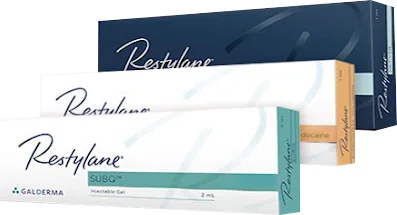
Restylane filler packaging stocked at Dear Clinic in Cheongdam
Both ranges sit on the same shelf here, which is why the recommendation can follow the scan.
Dear, Knowhow

How the choice between the two is actually made here

01 — THE FULL ARSENAL

Four HA families, no house favourite

Juvederm, Restylane, Belotero and the Korean Chaeum range are all stocked and all printed on the card.

02 — DIAGNOSIS FIRST

EVE Muse 3D picks the property, then the carton

Three-dimensional imaging under five light sources puts your ratios and volume deficits on screen, and the plan is written as a property specification: which firmness, which plane, how many tenths of a cc, in which area. A brand name is what satisfies that specification last. Where the reading finds laxity or skin quality instead of lost volume, we do not recommend either family that day, and the conversation moves to a lifting protocol or a booster.

03 — DIRECTOR-PERFORMED

The same vascular map applies to both gels

Every injection is performed by your director. Bruising at an entry point and swelling in the first days are ordinary with either family; the serious risk is vascular and identical for both, because any gel pushed into a vessel can cause skin necrosis or, rarely, visual loss. Slow, low-pressure placement in known planes is the safeguard, and it does not change with the brand on the syringe.
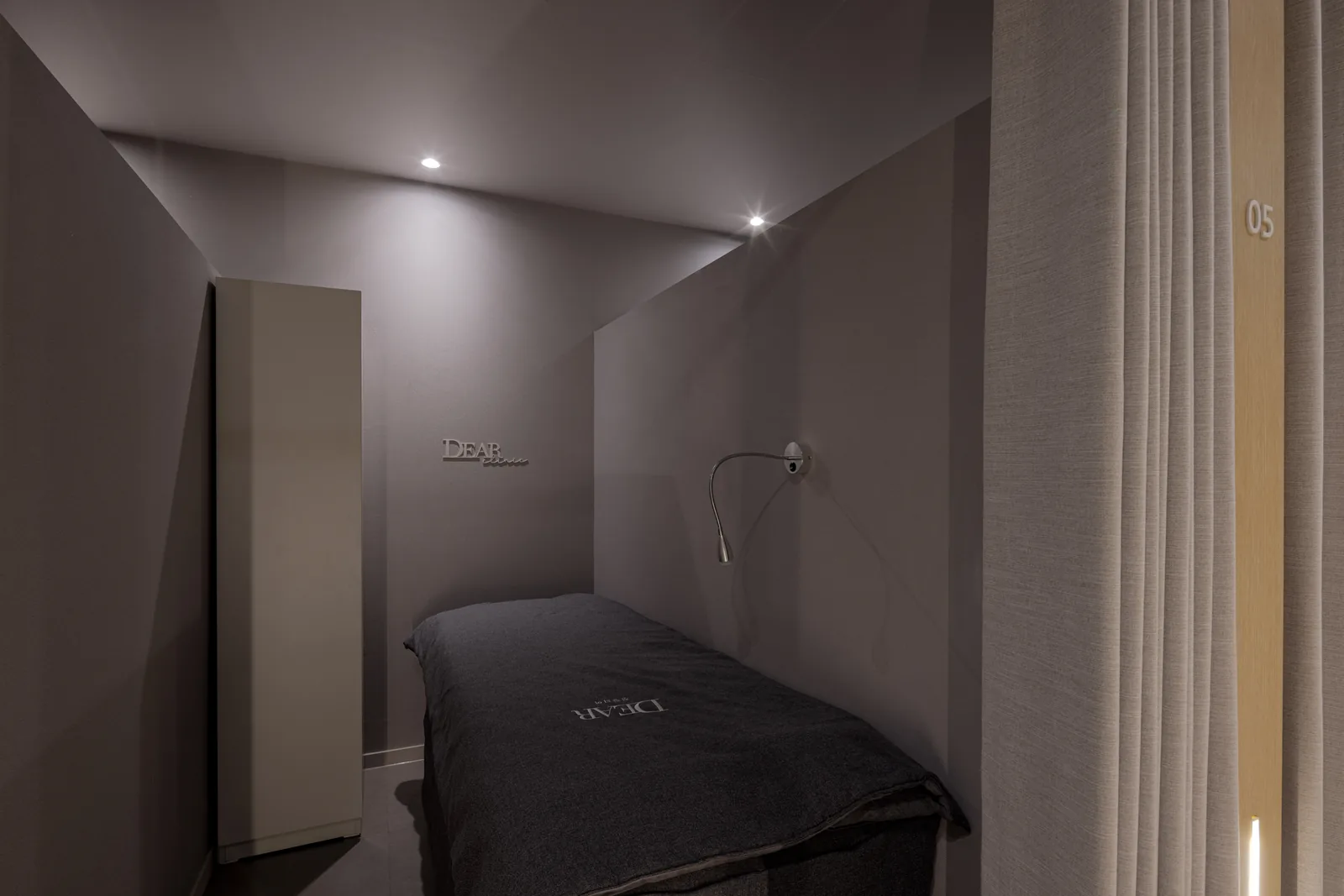
In the clinic

Both families on the same shelf

Private recovery bay at Dear Clinic with a DEAR-embroidered blanket and soft reading light
Medical Team

Five doctors, one standard

Director-performed treatment is a Dear promise — your procedure is planned and performed by the doctors below.


Dr. Jemin Kim — Medical Director and Founder, Dear Clinic
Dr. Jemin Kim
Yonsei University College of Medicine
Medical Director · Founder
Dr. Sanghyun Lee — Director, Dear Clinic
Dr. Sanghyun Lee
Seoul National University College of Medicine
Director
Board-certified · Family Medicine
Dr. Seonhaeng Lee — Director of Aesthetic Medicine, Dear Clinic
Dr. Seonhaeng Lee
Chosun University College of Medicine · Residency, Samsung Medical Center
Director, Aesthetic Medicine
Dr. Daeun Jung — Director, Dear Clinic
Dr. Daeun Jung
Ajou University College of Medicine
Director
Board-certified · Family Medicine
Dr. Woojae Jung — Director of Aesthetic Medicine, Dear Clinic
Dr. Woojae Jung
Seoul National University — B.S. in Medicine
Director, Aesthetic Medicine
Patient Reviews

What our patients say

Real verified reviews from our Google Business Profile.

4.9★★★★★ 310 Google Reviews
FAQ

Juvederm against Restylane, answered

What is the difference between Juvederm and Restylane fillers?
Both are cross-linked hyaluronic acid placed in the same anatomical planes, and both come from established manufacturers — AbbVie/Allergan and Galderma respectively. The difference is how the gel is built. Juvederm is characterised by its maker as smooth and cohesive, which favours blending across a surface; Restylane is characterised by a particulate structure, which favours holding a defined shape. Each name covers a range of firmness levels, so the practical comparison happens gel by gel at your consultation.
Which filler brand lasts longer, Juvederm or Restylane?
Dear Clinic does not publish a duration for either, because the variables that decide it are yours rather than the carton's: the specific gel chosen, the area, how much that area moves and your own metabolism. A chin holds a correction longer than a lip does in either family. Your director gives you an expected range for the gel your plan actually uses and measures what remains at the review.
Does Dear Clinic stock both, or recommend whichever is in the fridge?
Both families are stocked and both are printed on the published card, along with Belotero and the Korean Chaeum range. That matters because a clinic carrying one family can only recommend that family. Here the plan is written as a property specification from your scan — firmness, plane, volume in tenths of a cc — and the carton that satisfies it is chosen afterwards.
How much do they cost per cc in Seoul?
Juvederm is ₩400,000 (≈ $285) per 1 cc and Restylane is ₩350,000 (≈ $250) per 1 cc on the published Dear Clinic card, with the Korean house family at ₩130,000 (≈ $95) per cc for comparison. Specialty placements are quoted at the specialty-area rate whichever family is used. The volume your design needs is agreed at the diagnosis, so the total is known before anything is opened.
Can the two be combined in one appointment?
Yes, and a face frequently receives two gels, because deep support and a surface finish are different jobs. Pricing follows the volume of each gel used, so the quote is the two volumes added together. What governs the combination is sequence and plane: support goes in first and the finishing pass comes last, with both halves of the face compared after every layer.
Which one is better for lips?
Neither family wins that question outright, because both fields a lighter gel intended for mobile tissue. Lips are the most mobile area either is asked to fill, so softness and integration matter more there than structural strength, and the lighter members of both ranges are designed for exactly that. Which one your director opens depends on the existing lip structure, the ratio being corrected and how much definition you want at the border.
Is one of them safer than the other?
The safety profile that matters is shared. Both are hyaluronic acid, both carry the ordinary risks of bruising, swelling and a lump that needs evening up, and both carry the serious vascular risk that comes from any gel entering a vessel — skin necrosis, and in rare reported cases visual loss. The safeguard is anatomical: known planes, slow low-pressure placement, small increments, and a director who has mapped the danger zones for the area being treated.
Can either one be dissolved if I change my mind?
Yes. Hyaluronic acid from either family responds to a hyaluronidase enzyme injection, so a result can be reduced or cleared. Gel that has been in place for a long time tends to be firmer and may take more than one session to remove completely, which is why Dear Clinic asks to see the area in person before agreeing a dissolving plan.
Is the Korean house filler a reasonable alternative to both?
Frequently, yes. The Chaeum range at ₩130,000 (≈ $95) per cc is licensed cross-linked hyaluronic acid with its own viscosity options, and a well-matched house gel placed in the correct plane at the correct volume does more for a result than a premium gel placed carelessly. Where a design genuinely calls for a specific rheology only an imported range offers, your director says so and explains why.
Do foreign patients pay a different rate for either family?
No. One published card applies to residents and to international patients, and consultation is in English. What a visitor should plan for is settling time: swelling is most visible on the first day, particularly in the lips, so a design placed the evening before a flight home is worth moving earlier in the trip.
Can I decide at the appointment, and when is the clinic open?
Yes — that is the intended sequence. The scan and the consultation come first, the property specification is written from them, and you approve the gel and the volume before anything is opened. Dear Clinic is open 365 days a year, weekends and public holidays included, so the settling review fits inside a short stay.
Consultation

Ask which gel your area calls for

Send your questions — answered in English as soon as possible.

Scientific Evidence

Peer-reviewed references behind comparing two HA families

Comparing two brand names is only meaningful if the products are measurably different, and the literature on that question is about physics before it is about marketing. The first paper below sets out the rheologic and physicochemical measurements used to tell injectable hyaluronic acid products apart. The remaining three cover the assessment and injection guidance, the vascular danger zones and the ophthalmic complications that apply identically to whichever family is in the syringe.

Each reference resolves to a DOI in an indexed journal, and none of them ranks one brand above another.

  1. Fagien S et al. Rheologic and Physicochemical Properties Used to Differentiate Injectable Hyaluronic Acid Filler Products. Plastic & Reconstructive Surgery. 2019. doi:10.1097/prs.0000000000005429
  2. de Maio M et al. Facial Assessment and Injection Guide for Botulinum Toxin and Injectable Hyaluronic Acid Fillers: Focus on the Upper Face. Plastic & Reconstructive Surgery. 2017. doi:10.1097/prs.0000000000003544
  3. Scheuer J et al. Anatomy of the Facial Danger Zones: Maximizing Safety during Soft-Tissue Filler Injections. Plastic & Reconstructive Surgery. 2017. doi:10.1097/prs.0000000000002913
  4. Kato J et al. Visual loss after aesthetic facial filler injection: a literature review on an ophthalmologic issue. Arquivos Brasileiros de Oftalmologia. 2022. doi:10.5935/0004-2749.20220048

References are provided for information — outcomes vary by individual and are assessed at your diagnosis.

Book WhatsApp Call