

★★★★★
The clinic was very professional from start to finish. Doctor Jung was excellent and gentle with the treatment. I felt well looked after and everyone was outstanding. Happy with my service!

Both injectables are on our own list, and only one of them acts on the structure that makes a nasolabial fold. This page explains which part of the fold each material can reach, what the combination looks like when both appear in a plan, and the risk each one carries.
The test is simple enough to do in front of a mirror. Relax your face completely and look straight ahead. If the groove from the side of your nose toward the corner of your mouth is still there, a muscle relaxant will not remove it. If the groove only appears when you smile broadly and disappears the moment you stop, movement is contributing a great deal and the conversation changes.
Most faces sit somewhere between those two, which is why the assessment here records both positions. The treatment page for the fold itself, with protocol and recovery, is nasolabial fold filler; the toxin lines are set out on wrinkle botox.

A fold is one line in the mirror and two separate problems underneath it.
Fat and soft tissue above the fold descend with age and sit against the fixed line where skin is bound down. The result is a step: fuller above, hollow below. This is volume and structure, and hyaluronic acid is the only material on this page that can address it.
Years of folding along the same line leave a fixed groove in the skin, visible at rest and in every photograph. Support placed underneath softens the shadow it casts. A relaxant has nothing to act on here, because nothing is contracting.
The muscles that raise the upper lip pull cheek tissue upward across the fold every time you smile or speak, which is why the line looks deeper in a photograph taken mid-laugh. Botulinum toxin acts precisely here, on contraction, and nowhere else.
So the question in the title has a structural answer. Two of the three drivers are present while your face is still, and neither responds to a muscle relaxant. That is the reason a fold enquiry at Dear Clinic is answered with a reading before it is answered with a product.
The upper lip elevators do two jobs at once. They lift the corner of your mouth and the centre of your upper lip when you smile, and in doing so they push cheek tissue against the fold. Weaken them enough to flatten the fold and you have also weakened the smile they produce. The trade is visible to everyone who knows your face, and it is not a subtle effect.
That is why the published toxin lines here are written around areas where relaxation is the goal in itself. Our rate card lists wrinkle toxin by area, including the mouth corner, and a specialty-area line covering the salivary gland, the nostril, the temple, a gummy smile and the philtrum. The mouth corner is a real target with a real indication, and it sits beside the fold without being the fold. Lifting a downturned corner and filling a groove are two different requests.
Where someone arrives asking for toxin into the fold itself, we do not recommend it, and the reason is given plainly at the consultation. Asymmetry of the smile is the specific risk of placing dose into these elevators, and unlike a filler complication it cannot be reversed with an enzyme. It is waited out.
Read the first column as the thing you can see in the mirror. Everything to the right of it follows from that.
| What you see | What is actually happening | The matched line at Dear | Listed rate |
|---|---|---|---|
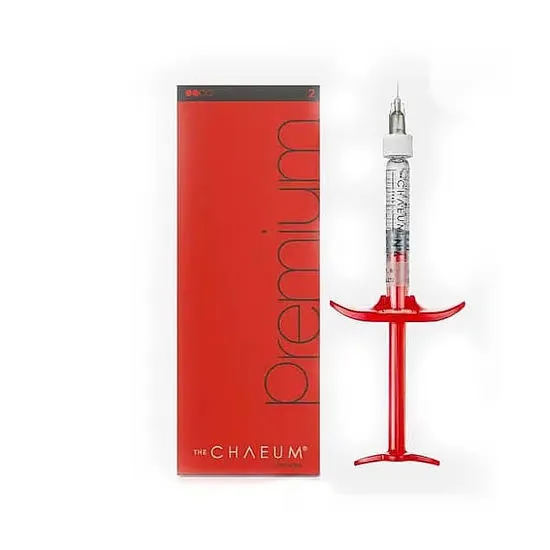
| A groove visible at rest, moderate depth | Mid-face support has descended and the crease is set | HA filler, standard-area rate per cc — premium Korean gel, placed by the plan | ₩130,000 (≈ $95) |
| A groove at rest with thin, mobile overlying skin | The same finding where the gel has to integrate smoothly under a thin cover | An imported HA chosen for its rheology — see Restylane | ₩350,000 (≈ $250) |
| A deep groove with real volume loss above it | A load-bearing correction, where most of the volume goes into the cheek and not the crease | A cohesive imported HA — see Juvederm | ₩400,000 (≈ $285) |
| Work that continues into a specialty area | The plan crosses into an area the rate card lists separately, such as the marionette line or the lip | Specialty-area filler, any brand, quoted per cc | ₩500,000 (≈ $355) |
| Lines that appear only in motion, on other parts of the face | Expression lines driven by contraction, which is what a relaxant is for | Wrinkle toxin by area, Korean tier | ₩30,000 (≈ $20) |
| The same, on an imported tier | The identical indication with the imported product line | Wrinkle toxin by area, imported tier | ₩150,000 (≈ $105) |
| A mouth corner that pulls downward | A specific muscle pulling the corner down, beside the fold and separate from it | Wrinkle toxin by area, Korean tier | ₩30,000 (≈ $20) |
| The same, on an imported tier | The identical indication with the imported product line | Specialty-area toxin, imported tier | ₩400,000 (≈ $285) |
Rates are published in KRW with an approximate USD figure beside them, and they are the same figures for visitors and residents. Filler is billed by the volume actually placed, so the total follows the plan and is agreed on screen before a syringe is opened. The whole card sits on the published price list, the gels themselves on the dermal filler category page, and the broader comparison of the two families on botox versus filler.
Combining the two is common, and it almost never means putting both into the same groove.
Choosing hyaluronic acid settles the material question. It does not settle where the material goes, and that is the part that decides how the result looks.
The fold is measured from the 3D capture at rest and in motion, and read together with cheek height and the position of the mouth corner. A groove is a symptom of a region, and the region is what gets planned.
Deep, mid and superficial planes behave differently under a fold. The load-bearing share goes deep where tissue is quiet; only what is needed goes close to the surface, because a superficial excess here reads as a ridge in daylight.
Dose is adjusted in increments as fine as 0.1 cc along the length of the groove, and both sides are compared as the work proceeds. Faces are asymmetric to start with, and matching them takes measurement.
The lower end of the fold meets the corner of the mouth, and overfilling that junction is what produces a heavy look. The finish point is decided against the corner, and the syringe is put down while there is still gel in it.
Unretouched, treated at Dear Clinic and shown with consent.
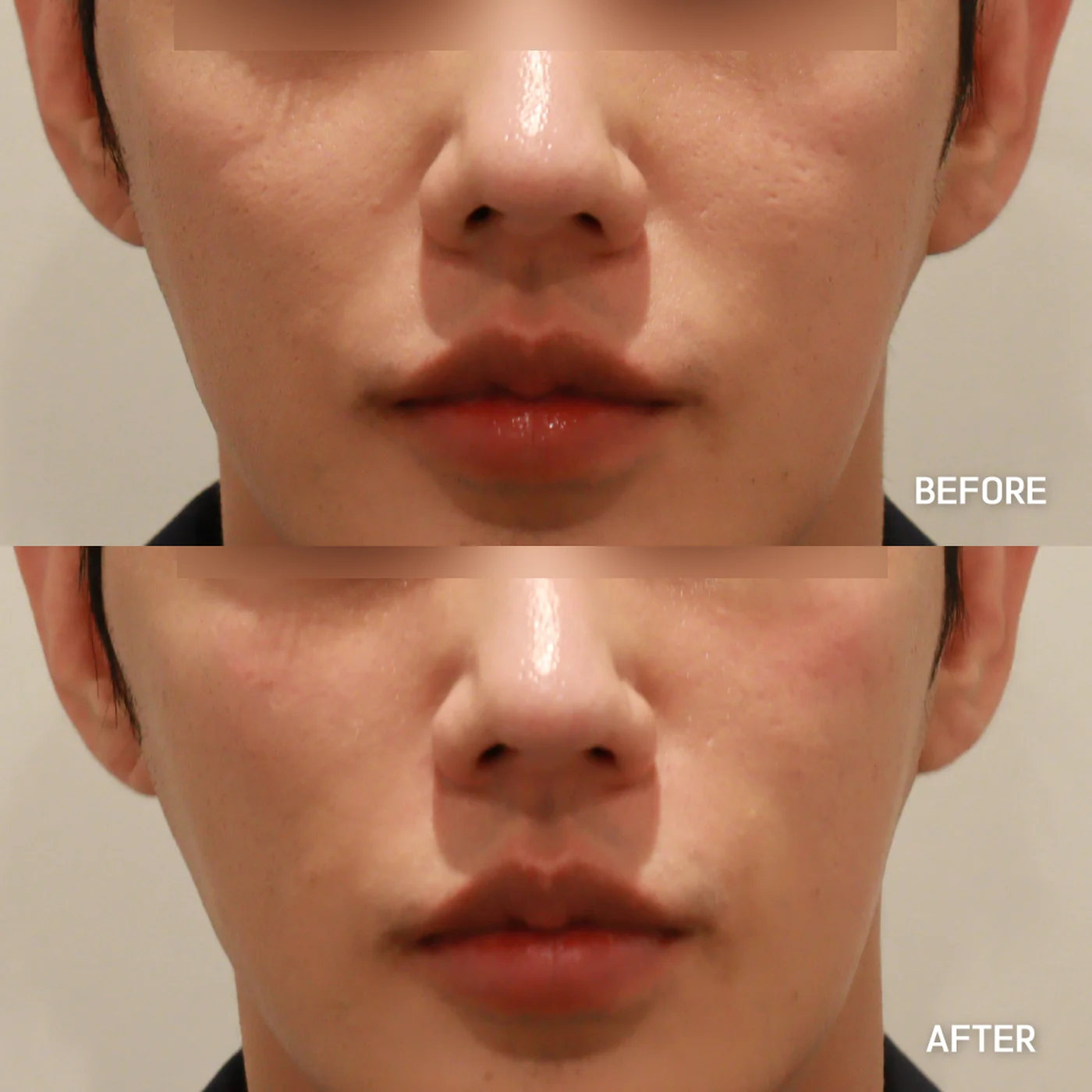
This is an unretouched before/after case of the same person under the same conditions, treated at Dear Clinic and shown with consent. Individual results may vary; no specific outcome is implied or promised.
The frame is taken at rest on purpose. A fold correction has to hold up in the position where the groove was actually graded, and a smiling after-photograph beside a neutral before-photograph is comparing two different faces.
Four hyaluronic acid lines and four toxin lines are published here, so nothing about the recommendation depends on which product we happen to stock. Where a fold needs a smaller correction than you came in asking for, saying so costs us revenue and nothing else.
EVE Muse captures in 3D under five light sources with AI analysis, and the groove is scored still and moving. Two positions, one decision.
Named vessels sit directly under the injection field, so the anatomy, the plane and the increments are a director’s work. The doctor who graded your fold is the doctor who places the gel and the one who sees you at the review.

We do not recommend an injection where the groove appears only in strong side lighting, where the complaint is skin quality along the line, or where a recent toxin dose is still altering how the face moves. Active infection or inflamed skin in the field postpones the appointment. Pregnancy, breastfeeding, bleeding disorders, blood-thinning medication and previous filler in the same region all change the plan and are raised at the consultation.
Outcomes differ between individuals and are assessed at your in-person diagnosis.
Director-performed treatment is a Dear promise — your procedure is planned and performed by the doctors below.





Real verified reviews from our Google Business Profile.
4.9★★★★★ 310 Google ReviewsThe clinic was very professional from start to finish. Doctor Jung was excellent and gentle with the treatment. I felt well looked after and everyone was outstanding. Happy with my service!
I've visited clinic for LDM procedure. I don't speak Korean, so there was an interpreter who assisted me while consulting. The staff was very attentive, they asked me every time before applying products/covering my face during the procedure and it went smoothly. Planning to visit the clini…
All the staff are kind, the doctor is professional. They recommended us the treatment that fit us best and last the longest. A very nice experience overall.
I did a hydrofacial, white/black head removal, and 1 day lasers. Really kind staff and reasonable prices. The only thing I would advise is that your first consultation is with a salesperson and you don’t see the doctor until after you decide what you want and after you pay.
Had a great experience here as a foreigner! The doctors and staff were knowledgeable, friendly, and not pushy. They made recommendations in my consultation and were happy to work within my budget.
Send a photograph at rest and one mid-smile. Answered in English as soon as possible.
Six indexed entries are listed below: two on the vascular anatomy and assessment of the injection field, one on the physical properties that separate hyaluronic acid products, one literature review of visual loss after facial filler, one on the enzyme used to dissolve hyaluronic acid, and one on the pharmaceutical properties of botulinum toxin type A products.
Each is given as title, journal and year with a verifiable DOI. No outcome figure from any of them is reproduced here, and none is evidence of a result in your own face.
References are provided for information — outcomes vary by individual and are assessed at your diagnosis.