

★★★★★
The clinic was very professional from start to finish. Doctor Jung was excellent and gentle with the treatment. I felt well looked after and everyone was outstanding. Happy with my service!
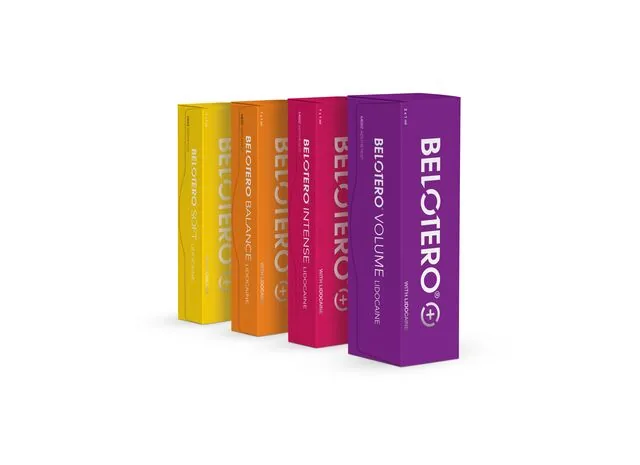
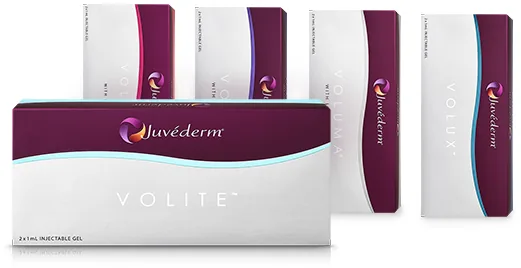
Both sit on the same shelf in Cheongdam, published at ₩300,000 and ₩400,000 per cubic centimetre. One is built to disappear into tissue at whatever density it meets; the other is built as a graded range with a firm end. The plane you are treating chooses between them.
Neither description is marketing shorthand invented for this page. Merz builds Belotero on a cohesive polydensified matrix, which is the reason the Korean product notes for the range emphasise how evenly it distributes through the skin and how rarely it leaves a palpable nodule. Juvederm is built on a cross-linking process the manufacturer patents, and the same Korean notes describe a viscous, firm gel supplied in different particle sizes so one range can serve several jobs.
What that means at a consultation is simple enough to state. Where the correction is shallow and the surrounding skin is thin, the gel that blends wins. Where the correction has to project something and carry the weight of tissue above it, the gel that resists deformation wins. The individual product page for each family goes further: Belotero at Dear and Juvederm at Dear.
The second and third rows carry the argument. Everything under them follows from how each gel is manufactured.
| Belotero | Juvederm | |
|---|---|---|
| Maker and origin | Merz, Germany | AbbVie / Allergan, United States |
| How the gel is built | Cohesive polydensified matrix — a patented process that produces varying densities within one gel instead of uniform particles | A patented cross-linking process producing a viscous, firm gel, supplied in a graded range of particle sizes |
| What that behaviour gives you | Integration into the surrounding tissue with very little tendency to sit as a discrete lump | Shape held under the weight of the tissue above it, with fine work possible from the softer members of the range |
| Lines within the family | Four lineups separated by their physical properties, so skin type and area select the member | A range whose particle size is matched to the area and to the kind of correction wanted |
| Anaesthetic in the syringe | Product dependent; confirmed for you from the carton actually opened | The Korean product notes state a lidocaine component in the gel, described by the maker as easing discomfort around placement |
| Planes used at Dear | Most often superficial and mid, where blending matters most | Deep and mid for structure, with softer members used higher |
| Planning unit | Written to 0.1 cc | Written to 0.1 cc |
| Reversible | Yes — hyaluronic acid responds to a hyaluronidase injection | Yes — the same enzyme applies |
| What you should expect afterwards | Entry-point bruising, short-lived swelling; superficial placement shows surface irregularity soonest if overdone | Entry-point bruising, short-lived swelling; deep placement shows as firmness before it settles |
| Published rate, per 1 cc | ₩300,000 (≈ $215) | ₩400,000 (≈ $285) |
Both figures are per cubic centimetre and both are the same for a resident of Seoul and a visitor. Specialty placements carry their own rate whichever family is opened, the whole card sits on the published price list, and every gel stocked here is set out on the dermal filler category page. Peer-reviewed work on injectable hyaluronic acid measures precisely these manufacturing differences, which is why a properties table is more useful here than a brand argument.
Starting positions, all of them movable by your own scan.
A crease sitting in the dermis under skin you can nearly see through is the textbook case for a gel that distributes instead of sitting as a mass. Firmness here reads as a ridge in side light, which is exactly the complaint people bring in after a shallow correction has been made with the wrong product.
Where the cheek has lost its platform, the gel underneath is holding everything above it. A firmer member of a graded range is the usual answer, and the cheek filler page sets out how the support is distributed.
Chin and jawline work asks a gel to push against soft tissue and keep its outline for months. That is a structural job, and it favours the firm end of the Juvederm range over anything designed to melt into its surroundings. See the chin filler page.
A nasolabial crease is often two problems in one: a genuine dermal line plus a shadow cast by cheek descent. The line takes a blending gel, the shadow takes support behind it, and sometimes both families appear in one plan. Detail on the nasolabial page.
Case 04 is the one worth reading twice. A comparison page implies you must pick a winner, and a full-face design frequently uses more than one family across different planes in a single appointment. How that is sequenced is described on the full-face filler page.
People ask about this before they ask about anything else, so it is worth being precise. The Korean product description for Juvederm states that a lidocaine component is present in the gel, and the manufacturer's position is that it eases discomfort around the injection itself. That is a property of the product on the shelf, and it is the kind of fact a comparison page should report plainly and then move on.
Three things it does not settle. It does not make an injection a non-event, because the needle passing through skin and the gel expanding tissue are separate sensations. It does not change which gel your plane calls for, and choosing a product for the ingredient instead of the correction is how people end up with the wrong material in the right place. And it does not describe what will be done for your comfort on the day, which depends on the area and on you.
Comfort measures during your session are confirmed at your consultation. Ask about them there, in the same conversation where the area, the volume and the published rate are agreed, and you will get an answer about your appointment instead of a statement about a carton.
Nothing in the comparison above changes any of this. Anatomy does not care which carton was opened.
Where the examination finds laxity instead of lost volume, we do not recommend either gel for it and say what would actually answer the complaint, usually something from the lifting and tightening category. Active infection over the area, pregnancy and breastfeeding postpone an appointment entirely, and blood-thinning medication or a bleeding disorder changes what you should expect and sometimes the plan itself.
One unretouched Dear case, shown with consent. The photograph records the correction, and it does not identify which family was used for it.
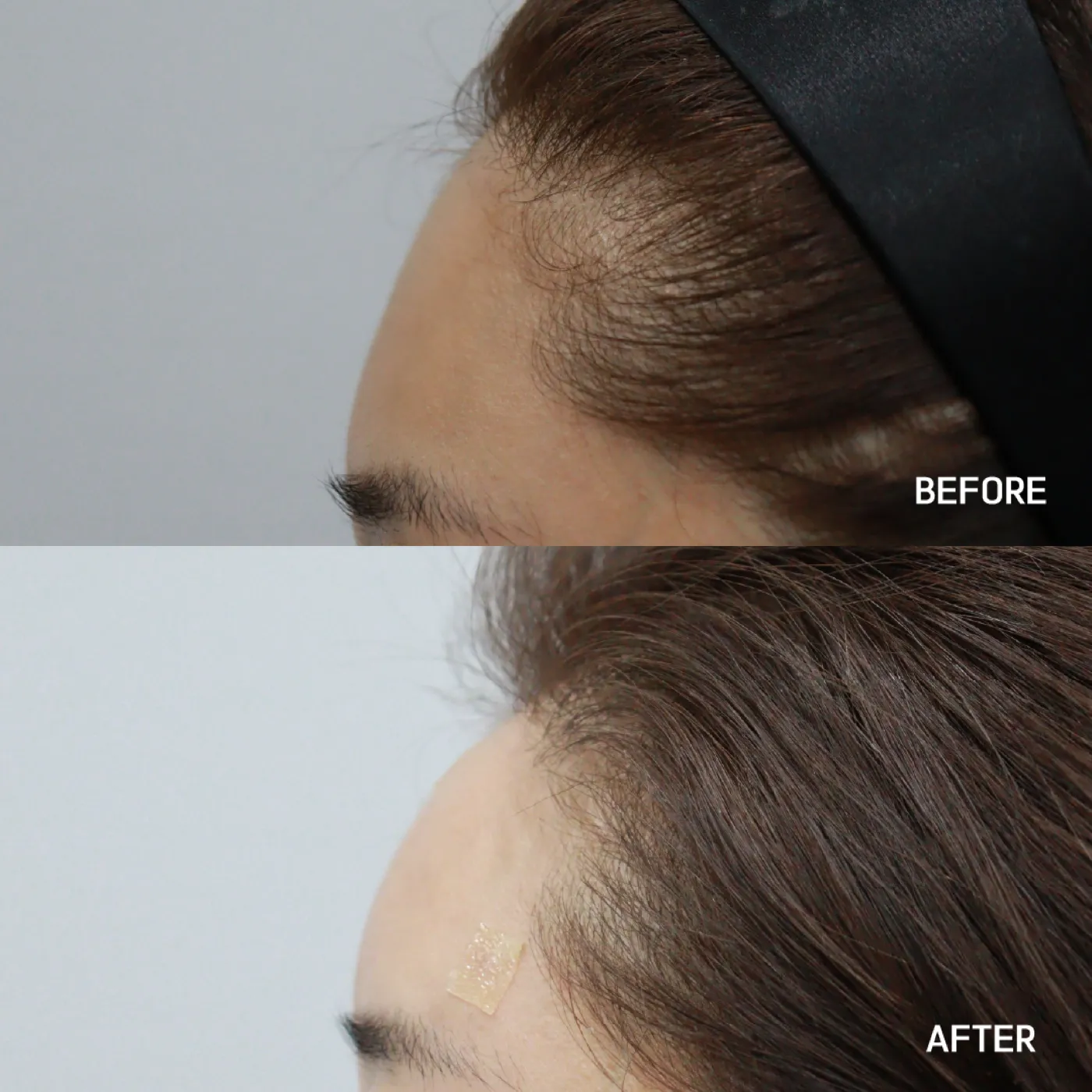
All photos are unretouched cases treated at Dear Clinic. Individual results may vary.
A forehead is a useful case for this comparison because it asks for both behaviours at once: volume placed deep enough to change the curve, and a surface smooth enough that no edge shows in raking light. The forehead filler page covers how the planes are divided.
Belotero and Juvederm are stocked alongside the Korean house family and a fourth imported range, so a recommendation here costs the clinic nothing either way. Where none of the four suits the finding, that answer is available too.
Three-dimensional capture under five light sources with AI analysis, read beside a hands-on examination, is what separates thin skin over a dermal line from tissue descent casting a shadow. Those two findings want different gels.
Every injection here is director-performed, in increments as small as 0.1 cc, and the same doctor sees you afterwards. Recognising a change in tissue you placed yourself is faster than reading notes written by someone else.
Director-performed treatment is a Dear promise — your procedure is planned and performed by the doctors below.





Real verified reviews from our Google Business Profile.
4.9★★★★★ 310 Google ReviewsThe clinic was very professional from start to finish. Doctor Jung was excellent and gentle with the treatment. I felt well looked after and everyone was outstanding. Happy with my service!
I've visited clinic for LDM procedure. I don't speak Korean, so there was an interpreter who assisted me while consulting. The staff was very attentive, they asked me every time before applying products/covering my face during the procedure and it went smoothly. Planning to visit the clini…
All the staff are kind, the doctor is professional. They recommended us the treatment that fit us best and last the longest. A very nice experience overall.
I did a hydrofacial, white/black head removal, and 1 day lasers. Really kind staff and reasonable prices. The only thing I would advise is that your first consultation is with a salesperson and you don’t see the doctor until after you decide what you want and after you pay.
Had a great experience here as a foreigner! The doctors and staff were knowledgeable, friendly, and not pushy. They made recommendations in my consultation and were happy to work within my budget.
Tell us which region you are considering, anything already injected there, and anything in your history touching bleeding or immunity. Answered in English as soon as possible.
Five indexed entries sit behind the statements above: a 2019 paper on the rheologic and physicochemical properties used to tell injectable hyaluronic acid products apart, two 2017 papers on facial danger-zone anatomy and on assessment and injection guidance for the upper face, a 2022 ophthalmology review of visual loss following aesthetic facial injection, and a 2016 review of hyaluronidase in aesthetic medicine.
Each is listed as title, journal and year with a verifiable DOI. None of them ranks one brand against another, no outcome figure from any of them is reproduced here, and none of them predicts what either gel will do in your own face.
References are provided for information — outcomes vary by individual and are assessed at your diagnosis.