

★★★★★
The clinic was very professional from start to finish. Doctor Jung was excellent and gentle with the treatment. I felt well looked after and everyone was outstanding. Happy with my service!

A wrinkle made by a muscle folding the skin and a wrinkle carved into the skin itself are two different objects. One answers to toxin, one answers to hyaluronic acid, and telling them apart is a thirty-second examination that happens before any product is chosen.
Both treatments are performed at Dear Clinic and both are published on the same rate list, which is what makes the examination worth trusting: there is no product here that needs finding a use for. What decides the plan is the reading, and the reading has two more layers beneath the first one — how deep the crease has been cut, and whether the tissue around it has flattened.
The third possibility is the one people forget. A face can have neither problem and simply carry dull, finely crinkled surface over healthy structure, which is a skin-quality complaint and answers to neither injection in its classic form. That reading sends the conversation to skin treatments, and your director will say so before anything is drawn on your face. For a broader view of how the two materials differ outside the wrinkle question, the general comparison sits on the botox and filler page.
The same face usually needs different answers in different thirds, which is why a plan written for one zone rarely transfers to another.
| Where the line is | What is making it | The matched route |
|---|---|---|
| Forehead, horizontal | A broad flat sheet lifting the brow and folding the skin above it | Toxin, dosed against how much brow lift you can afford — see wrinkle botox |
| Between the brows | Small muscles drawing the brows inward and down when you concentrate | Toxin, counted as its own treated area |
| Crow's feet | The ring of muscle around the eye squeezing on every smile | Toxin, its own area again, with the outer fibres mapped individually |
| A forehead that reads flat or dented | Contour, not movement — the plane itself has lost its curve | Hyaluronic acid on the forehead line — see forehead filler |
| Nose-to-mouth folds and marionette lines | Volume that has descended and flattened, deepening a shadow at rest | Hyaluronic acid, usually placed where the support was lost as much as in the fold |
| Hollows under the eye and along the cheek | Structural loss producing a shadow that photographs as a line | Hyaluronic acid, at a layer and a volume set by the scan |
| Fine crinkling across the whole face | Surface quality, with very little muscle folding behind it | Micro-dosed full-face toxin, or skin treatments — see skin botox |
Two of those rows are worth pausing on. A flat forehead and a lined forehead are the same anatomical region asking opposite questions, and the products that answer them are not interchangeable. And a fold that only appears when you smile is not the same finding as one visible while your face rests, which is the distinction the nasolabial filler page works through in detail.
Both are in stock here, both are published, and the row that decides your plan is the first one.
| Botulinum toxin type A | Hyaluronic acid filler | |
|---|---|---|
| The wrinkle it matches | Dynamic — visible only while the muscle is working | Static — visible on a face that is completely still |
| Mechanism | Reduces the signal reaching a muscle, so it folds the skin less forcefully | Occupies space in the tissue, supporting the crease and what sits beside it |
| Where it is placed | Into or immediately above the target muscle, at a depth set by the zone | At a chosen anatomical layer — deep, mid or superficial — to 0.1 cc precision |
| How the plan is counted | By treated area and by tier | By cubic centimetre and by product family |
| When it shows | Nothing on the day; the softening arrives over the days that follow | Visible as it is placed, then settles as swelling resolves |
| Downtime | Small entry-point marks, occasional bruise, ordinary activity straight away | Swelling, tenderness and entry-point bruising for a few days |
| If you dislike it | It has to wear off; there is no reversal agent | Hyaluronidase can dissolve the gel in a separate appointment |
| Listed rate, Korean tier | Per wrinkle area ₩30,000 (≈ $20); full-face micro-dosing ₩150,000 (≈ $105) | 1 cc from ₩130,000 (≈ $95); the forehead line at ₩180,000 (≈ $130) |
| Listed rate, imported tier | Per wrinkle area ₩150,000 (≈ $105) | 1 cc at ₩350,000 (≈ $250) or ₩400,000 (≈ $285) depending on the family chosen |
Korean pharmaceutical advertising rules keep prescription toxin product names off public pages, so the toxin column shows tiers; your director names the product in the room. Every figure above is the published rate, identical for residents and visitors, and intermediate tiers and specialty-area rates sit on the price list. No duration in months is printed for either material, because how long a dose holds and how long a gel lasts both move with the area, the amount placed and your own metabolism — your director gives you the expected pattern for the exact plan you approve.
A single appointment often carries both materials on one face: toxin across the upper third, hyaluronic acid in the mid and lower third. Each area and each cubic centimetre is quoted as its own line, and you approve the list before any of it begins.
On the toxin side the failures are about position and amount. A heavy forehead dose can lower the brow and leave the upper lid feeling weighted. An uneven map can peak one eyebrow above the other. Spread beyond the intended muscle can alter a smile or how the lower lip sits. Bruising at an entry point, brief swelling and a headache in the first day or two are the ordinary events. Every one of those is temporary, and every one of them has to be waited out, because nothing reverses a toxin dose.
On the filler side the ordinary events are swelling, tenderness and bruising over a few days, with lumps, visible edges and asymmetry as the correctable ones. The serious risk is vascular: gel entering or compressing a vessel can starve the skin it supplies, and in the worst reported cases the eye. That is why pain out of proportion to the procedure, skin turning white or dusky over a treated area, or any change in vision means telephoning the clinic the same hour and not waiting for a review. Hyaluronidase, the enzyme that dissolves hyaluronic acid, is both the correction for a result you dislike and part of how that emergency is managed.
Neither material is offered during pregnancy or breastfeeding, or where there is infection, inflamed skin or an open wound in the field to be treated. A neuromuscular condition in your history changes what can be offered on the toxin side entirely. Tell your director about blood-thinning medication or supplements, about previous injectable work and what was used, and about any reaction you have had before. Where the finding is laxity that needs lifting, or a surface complaint that needs skin treatment, we do not recommend either injection, and that conversation happens before payment. Results vary between individuals and suitability is decided at your own examination.
Where the forehead complaint turned out to be contour instead of movement, the correction was hyaluronic acid and no toxin was used.
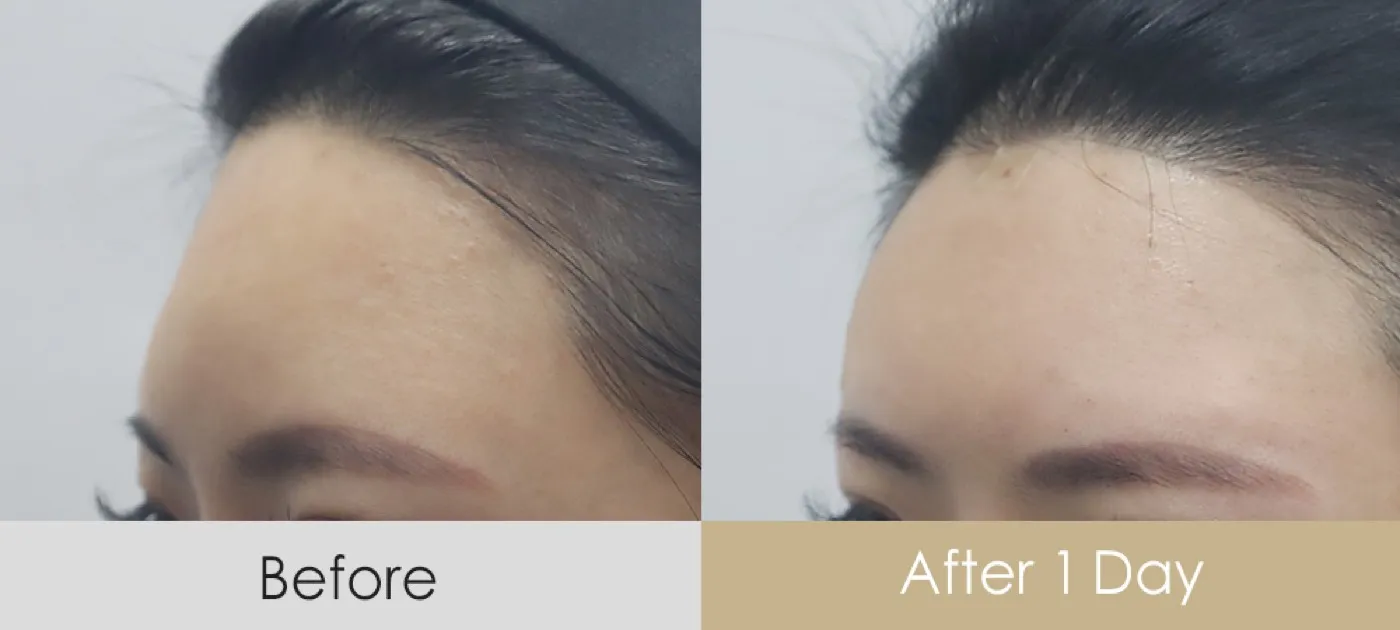
Unretouched case treated at Dear Clinic and shown with consent, labelled only with the treatment it actually received. Individual results may vary.
It is the clearest illustration of why the examination comes before the product. The same forehead, presenting with horizontal lines instead of a flattened plane, would have been a toxin plan at a different rate on a different part of the price list.
Toxin across its tiers and four hyaluronic acid families sit in the same building, published in the same list, so the examination is free to land wherever it lands.
Three-dimensional capture under five light sources with AI analysis records the face at rest and mid-expression, and the difference between those two images is the dynamic share of every line on it. A groove that measures the same in both is static, and no amount of looking in a mirror will tell you that as reliably as two captures set side by side.
Over-relaxed and over-filled are the two ways injectable work announces itself, and both are hard to walk back. Planning and injection are director-performed here, at the least that achieves what was agreed, with room left to add at a review.

Director-performed treatment is a Dear promise — your procedure is planned and performed by the doctors below.





Real verified reviews from our Google Business Profile.
4.9★★★★★ 310 Google ReviewsThe clinic was very professional from start to finish. Doctor Jung was excellent and gentle with the treatment. I felt well looked after and everyone was outstanding. Happy with my service!
I've visited clinic for LDM procedure. I don't speak Korean, so there was an interpreter who assisted me while consulting. The staff was very attentive, they asked me every time before applying products/covering my face during the procedure and it went smoothly. Planning to visit the clini…
All the staff are kind, the doctor is professional. They recommended us the treatment that fit us best and last the longest. A very nice experience overall.
I did a hydrofacial, white/black head removal, and 1 day lasers. Really kind staff and reasonable prices. The only thing I would advise is that your first consultation is with a salesperson and you don’t see the doctor until after you decide what you want and after you pay.
Had a great experience here as a foreigner! The doctors and staff were knowledgeable, friendly, and not pushy. They made recommendations in my consultation and were happy to work within my budget.
Send one photograph completely at rest and one mid-expression — answered in English as soon as possible.
Six references, three on each material. On the toxin side: the first published account of treating expression lines, an international consensus education initiative on aesthetic use, and a laboratory review of how the licensed type A products differ. On the filler side: an injection guide covering both materials in the upper face, a study of the physical properties that separate hyaluronic acid gels from one another, and an anatomical account of the facial regions where vascular risk is concentrated.
They describe the materials and the anatomy. They do not describe your face, prescribe an area or a volume for it, or attach a timeline to either, and each one carries a verifiable DOI from an indexed journal.
References are provided for information — outcomes vary by individual and are assessed at your diagnosis.