

★★★★★
The clinic was very professional from start to finish. Doctor Jung was excellent and gentle with the treatment. I felt well looked after and everyone was outstanding. Happy with my service!
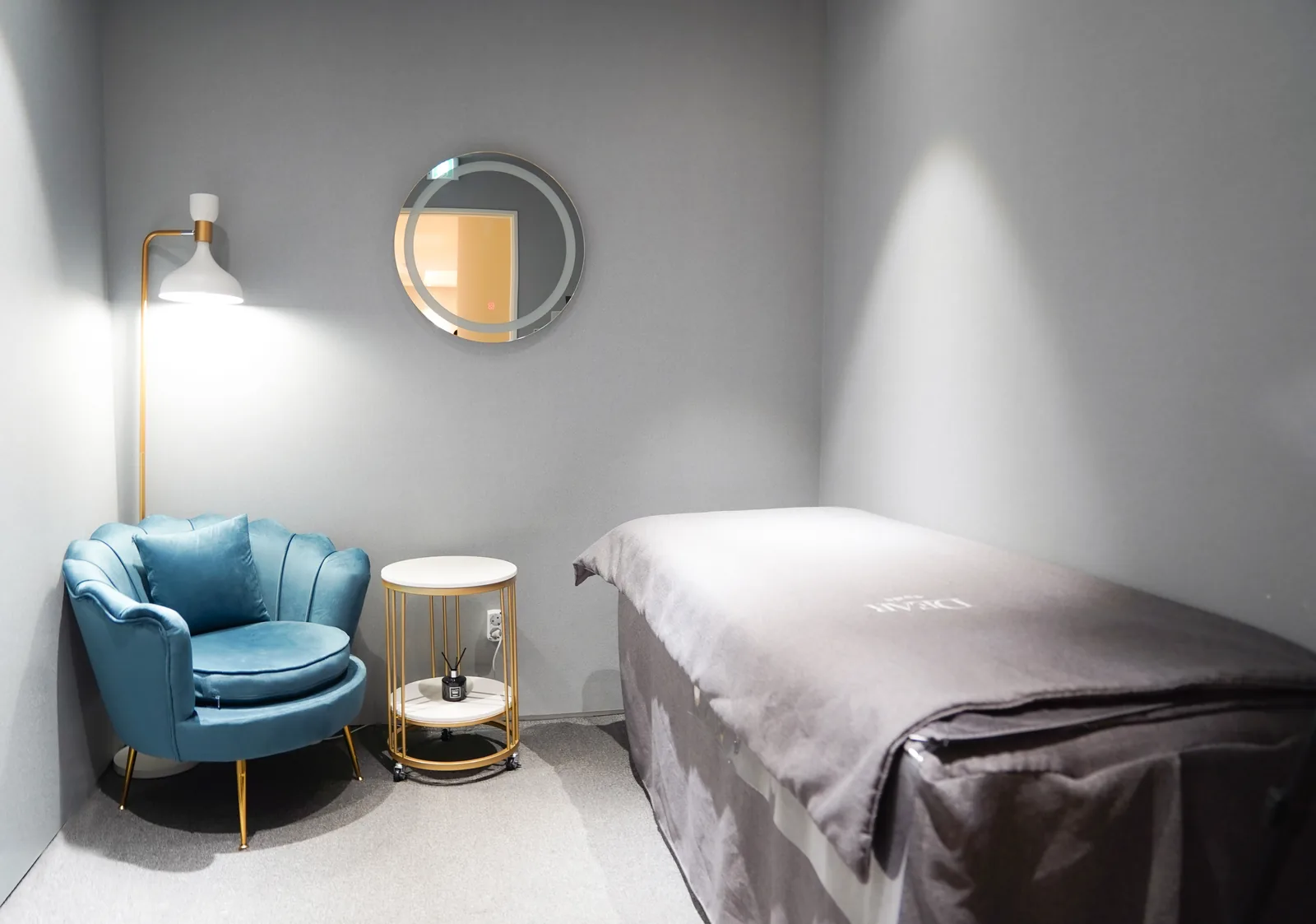
There is something to feel, and pretending otherwise helps nobody. Most people describe a short sting where the needle enters and a firm pressure as the gel spreads underneath — strongest nearest the mouth corner, mildest in the cheek above the groove, where a good deal of the volume usually goes.
Two things about our planning change that experience before anything is injected. The first is that a fold is frequently treated from above: where the reading finds the crease is driven by a mid-face that has descended, most of the volume is assigned to the cheek, and the cheek is markedly less sensitive than the groove itself. The second is that the map is drawn first, so the number of entry points is fixed in advance and each pass is planned before it is made.
One product fact is worth knowing if discomfort is your main worry: Juvederm carries lidocaine within the syringe, which is part of why it is often chosen for sensitive placements. Whether that family suits your fold is a separate question, and the reading answers it; either way the choice is discussed with you before treatment begins.
Sensation over a smile line is not uniform. It follows the depth of the pass and the distance from the mouth.
| Where the pass goes | How it tends to feel | What is being done about it |
|---|---|---|
| The entry point | A short, definite sting lasting a second or two. Bruising, when it happens, usually starts here rather than along the fold. | Entry points are fixed on the map before the session, so there are as few of them as the design allows. |
| The deep plane, over bone | Heavy pressure and a dull ache instead of a sharp pain. Most people find this the strangest part of the appointment; few call it the worst. | The gel is advanced slowly and at low pressure, which is also the safety requirement in this region. |
| The cheek above the fold | The mildest zone of the appointment. Pressure, and a sense of fullness building. | Where descent drives the groove, this is where the larger share of the plan is placed. |
| The mouth corner | The tenderest point, particularly for a fine superficial correction near the skin surface. | Worked last, in small increments, with the side compared before the pass is finished. |
Pain thresholds differ enormously, and so do the plans: a crease refinement and a mid-face rebuild are not the same appointment. Nothing here is a promise about your own session.
Comfort in this region is mostly a by-product of planning. Fewer passes, correct depth, and the shape judged before swelling arrives.
The EVE Muse 3D capture under five light sources shows whether you have a true skin crease, a fold created by a cheek that has dropped, or both together. That grading decides where the first pass goes, and a plan that starts in the right place needs fewer corrections later.
Placement is distributed across the Deep, Mid and Superficial planes, each with its own written allowance. Support built underneath means the delicate superficial work near the mouth can stay small.
Gel concentrated at one deposit tightens the tissue around it, which is uncomfortable at the time and visible afterwards. Distributing by layer along the groove keeps the pressure sensation even, and the two sides are compared with you sitting upright while there is still time to adjust.
The corrected line is fitted to the cheek flow and the corner of the mouth and checked in motion. Knowing when a fold is finished is what keeps the last, most sensitive minutes short.
Every pass is director-performed. The facial artery and its angular branch run close to this groove, so the depth and the speed are not negotiable here, and the same person who graded your fold holds the syringe over it.
The published safety literature on soft-tissue fillers is specific about what matters here. So are we.
| What you notice | How to read it | What to do |
|---|---|---|
| Tenderness, swelling, a small bruise | Ordinary. The tissue has been opened and water has been drawn into the gel. | Keep the area cool and unpressed; carry on as normal otherwise. |
| The fold looks over-filled | Common in the first days while swelling is at its height. | Wait for the review appointment before judging the correction. |
| A firm point or slight unevenness along the groove | Can happen, and is usually correctable — including by dissolving the gel. | Tell us at the review, or call if it is bothering you sooner. |
| Skin turning white, mottled or dusky | Not ordinary. Blanching is the first sign the literature flags for vascular compromise. | Contact the clinic immediately, on the same day. |
| Pain that escalates instead of easing | Not ordinary. Discomfort should decline day by day. | Contact the clinic immediately. |
| Any change in vision | Rare and serious; visual loss after facial filler is documented in the ophthalmology literature. | Contact us immediately and seek urgent medical care. |
This is the reason a fold is director-performed here, placed slowly in mapped planes, with hyaluronidase kept within reach in the room. It is also why we decline some requests outright: a groove that would barely move under gel is not worth the exposure, and skin carrying active inflammation or infection at the entry points is treated another day. Where your reading puts the cause in cheek descent, what we recommend may be a lifting session and no injection into the fold at all.
Unretouched, shown with consent. Individual results vary.
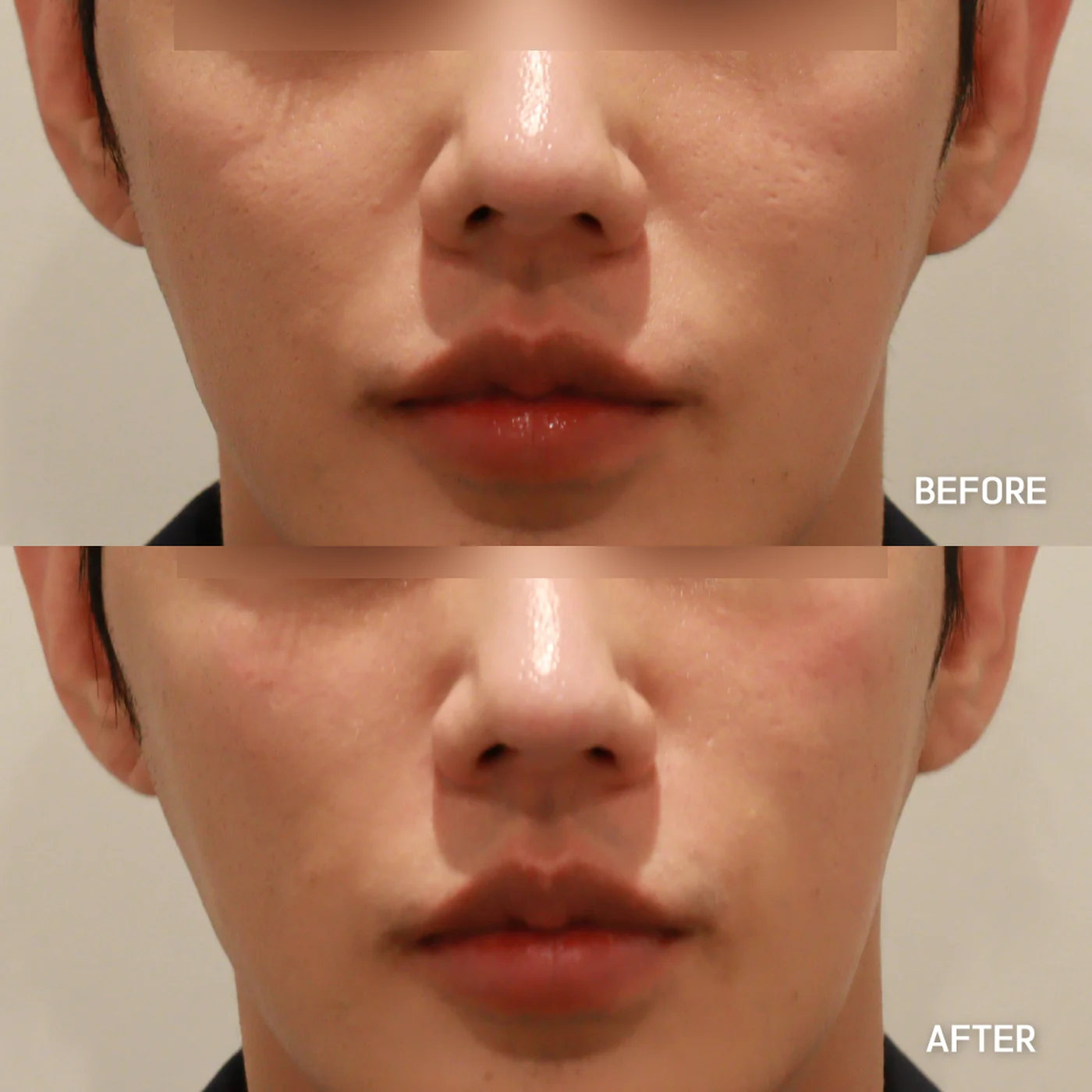
All photos are unretouched before/after cases of the same person under the same conditions, treated at Dear Clinic and shown with consent. Individual results may vary; no specific outcome is implied or promised.
The nasolabial fold filler page sets out the anatomy, the three-plane protocol and further cases, and the dermal filler hub covers every area we treat with hyaluronic acid.
| Hyaluronic acid, per 1 cc | Note | Listed rate |
|---|---|---|
| The Chaeum | Our Korean house family, standard per-cc line | ₩130,000 (≈ $95) |
| Belotero (Germany) | CPM multi-density particles, few nodules, four lines | ₩300,000 (≈ $215) |
| Restylane | Swedish family, FDA and CE certified | ₩350,000 (≈ $250) |
| Juvederm | Vycross cross-linking; lidocaine within the syringe | ₩400,000 (≈ $285) |
Published rates as of September 2026; KRW is what you pay and USD is shown for reference only. The card is the same for residents of Seoul and for international patients, with no visitor surcharge, and consultation is conducted in English. Anything beyond the volume placed — a review visit, aftercare, any additional treatment — is quoted to you at consultation, never assumed. The transparent price list carries every other published rate.
Director-performed treatment is a Dear promise — your procedure is planned and performed by the doctors below.





Real verified reviews from our Google Business Profile.
4.9★★★★★ 310 Google ReviewsThe clinic was very professional from start to finish. Doctor Jung was excellent and gentle with the treatment. I felt well looked after and everyone was outstanding. Happy with my service!
I've visited clinic for LDM procedure. I don't speak Korean, so there was an interpreter who assisted me while consulting. The staff was very attentive, they asked me every time before applying products/covering my face during the procedure and it went smoothly. Planning to visit the clini…
All the staff are kind, the doctor is professional. They recommended us the treatment that fit us best and last the longest. A very nice experience overall.
I did a hydrofacial, white/black head removal, and 1 day lasers. Really kind staff and reasonable prices. The only thing I would advise is that your first consultation is with a salesperson and you don’t see the doctor until after you decide what you want and after you pay.
Had a great experience here as a foreigner! The doctors and staff were knowledgeable, friendly, and not pushy. They made recommendations in my consultation and were happy to work within my budget.
Tell us what the smile line does when you are resting and when you smile — answered in English as soon as possible.
The papers below are the basis for the urgent column of that table, not for any statement about how your own appointment will feel. They document the vascular anatomy that makes this region director-only, the ophthalmic complication that makes blanching and visual change an emergency, how facial assessment guides where a gel is placed, and how hyaluronic acid is dissolved when it has to come out.
Each reference resolves to a DOI in an indexed journal.
References are provided for information — outcomes vary by individual and are assessed at your diagnosis.