

★★★★★
The clinic was very professional from start to finish. Doctor Jung was excellent and gentle with the treatment. I felt well looked after and everyone was outstanding. Happy with my service!
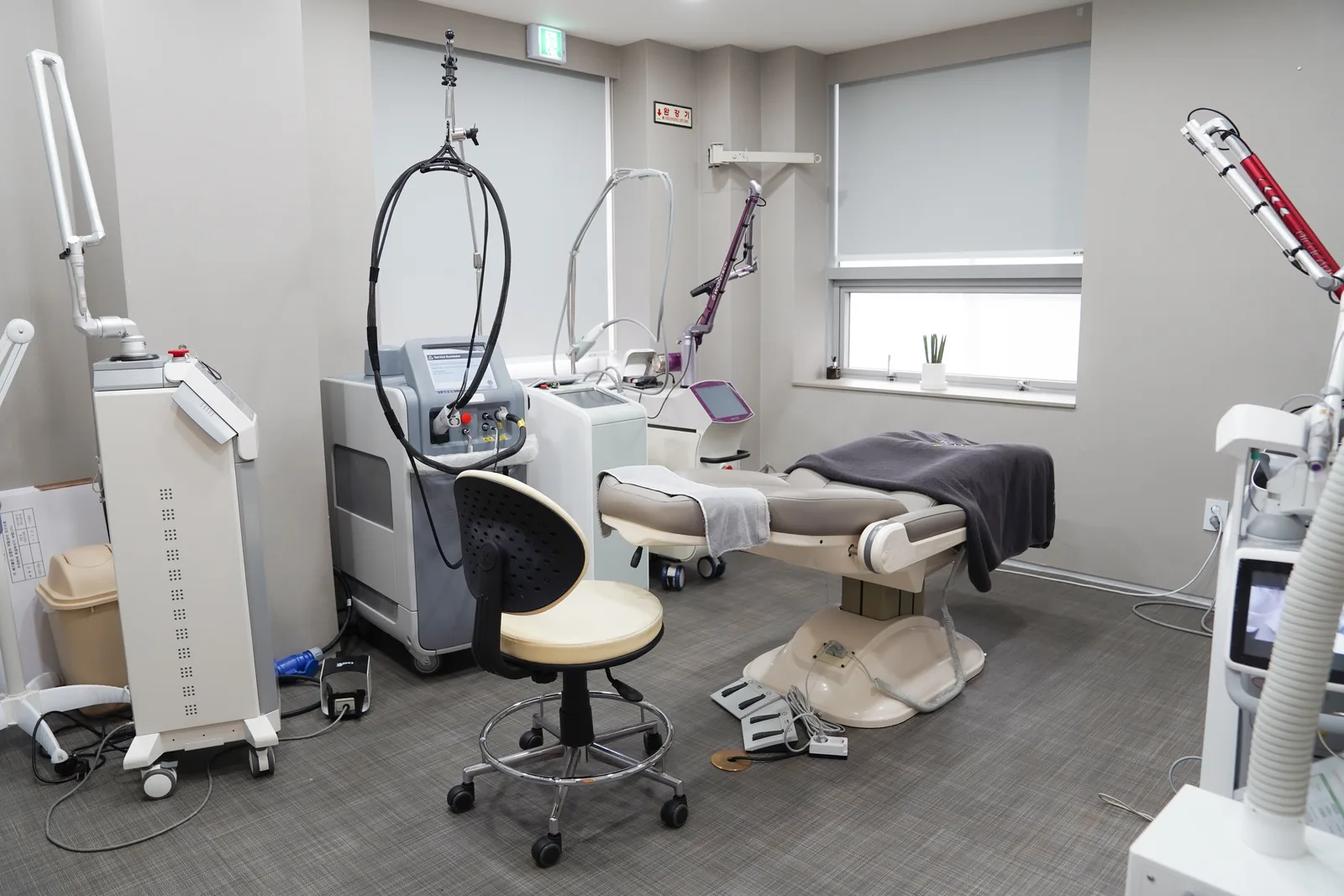
Body ink is listed at ₩90,000 for each five centimetres treated at a visit, and eyebrow or eyeliner work at ₩150,000 for the region. A larger piece is quoted as a multiple of that unit, agreed with you at the consultation.
| Published line | What one charge buys | What multiplies it | Listed rate |
|---|---|---|---|
| Body ink | One visit of laser work across five centimetres of tattoo | The units your piece is counted as, then the visits it turns out to need | ₩90,000 (≈ $65) |
| Eyebrow or eyeliner | One visit of laser work across a cosmetic-tattoo region | Visits only — the region is a single unit whatever its shape | ₩150,000 (≈ $105) |
Rates are published in Korean won and settled in won at the desk; a dollar equivalent is shown beside them so that somebody converting from abroad has an orientation figure, and it moves with the exchange rate. The two lines are identical for people who live twenty minutes away and for people who flew in this morning — a foreign passport adds no surcharge to either. Every other published figure at the clinic sits on the full price list, and the treatment route itself, from the first pass through the healing week, is laid out on the tattoo removal page.
The unit describes a span of ink, so the first number in your quote is a count and not a session ticket.
Counting happens with the area uncovered in front of you, and the figure is agreed before anything is switched on. There is no formula applied to a photograph sight unseen, which is why a quote sent by message carries the word provisional on it until somebody has looked at the piece. What follows describes the questions that settle a count, and your director confirms how your own tattoo comes out at the consultation.
Send a photograph in daylight with a coin or a ruler lying beside the tattoo if you want a provisional count before you travel. It gives your director something to scale from, and it makes the figure you receive in the reply closer to the one written on the tablet when you arrive.
All four were fixed before you walked in, and none of them changes the published line. They change how many times it gets paid.
Dense black and blue-black generally give way soonest under laser light. Greens, bright blues, yellows and several reds hold on considerably longer, and white or flesh-toned pigment used to patch earlier work can behave in ways nobody predicts from looking at it. A design carrying four colours therefore lifts at four speeds.
Studio work sits deeper and is packed tighter than hand-poked ink. A cover-up holds two tattoos in the same square centimetre, and a piece retouched over several years holds more pigment than its surface suggests. That buried quantity is the reason a small dense emblem can outlast a large open outline.
Ink that has been in the skin for two decades has already lost some of itself to ordinary immune traffic, and it starts from further along. Where it sits matters for the same reason: designs on the trunk and upper arm usually move faster than those on ankles, feet and hands, where circulation is thinner.
Deeper skin tones are worked with more conservative settings, which protects the skin surrounding the design and lengthens the calendar instead of shortening it. A fresh tan postpones an appointment instead of modifying it, and the visit is simply rebooked into the next slot.
How many visits your own piece is likely to need comes to you as a range at the consultation, and that range is rewritten at each appointment against the photographs from the last one. A range is an estimate of the work ahead and carries no finishing date with it. Complete clearance cannot be promised, and a residual shadow or a faint ghost of an outline can remain when a long course has run its distance.
Nothing here is pre-sold as a block. Each visit is settled on the day it happens, so a course that stops after the second appointment leaves nothing owed and no unused balance sitting with the clinic. Measures for your comfort during a session are discussed with your director and confirmed at consultation.
The figure people find hardest to plan around is the one nobody can hand over on day one. What we can hand over is the per-visit number, in writing, with the count of units it rests on, and a range for how often it is likely to be paid.
Three situations get a plain no here, and all three are cheaper to hear now than after a first payment. We do not recommend starting when the tattoo has to be gone for something a few weeks away, because the interval between visits cannot be compressed to suit a date. We decline when the skin over the ink is sunburnt, actively tanned or still healing from anything at all. And we say so when your dates in Korea cannot hold a second appointment or a return trip, since the opening visit of a course that cannot continue is a poor use of your money.
The risks of the method belong in a pricing conversation as much as anywhere. Blistering and scabbing can follow a session and are the reason the treated area is left strictly alone while it closes. Temporary lightening or darkening of the treated skin happens, and occasionally it lasts. Scarring is uncommon but real, and scarring left behind by the original tattooing can become more visible as the ink covering it fades. Sun on treated skin is the most frequent cause of lasting discolouration, which is why sunscreen belongs in the budget alongside the visits.
Where the plan is to be re-tattooed over the same area later, say so at the start. Lightening is a shorter target than clearing, and a tattooist who can tell us how much fading the replacement design actually needs will usually save you appointments. Outcomes vary between individuals and are assessed on your own examination.
Units, then the line, then the visits. Three numbers, all of them shown to you, none of them bundled out of sight.
Three-dimensional imaging under five light sources with AI analysis gives your skin type, how your own pigment behaves under energy, and the state of the skin immediately around the design. Those readings decide how conservatively the course has to be paced, and pacing is what the visit count in your budget ultimately rests on.
Your director measures the piece, writes the figure, and the session itself is performed by your director too. Settings for the next visit come from the photographs of the last one, so the estimate is revised by somebody who watched your skin respond.

Director-performed treatment is a Dear promise — your procedure is planned and performed by the doctors below.





Real verified reviews from our Google Business Profile.
4.9★★★★★ 310 Google ReviewsThe clinic was very professional from start to finish. Doctor Jung was excellent and gentle with the treatment. I felt well looked after and everyone was outstanding. Happy with my service!
I've visited clinic for LDM procedure. I don't speak Korean, so there was an interpreter who assisted me while consulting. The staff was very attentive, they asked me every time before applying products/covering my face during the procedure and it went smoothly. Planning to visit the clini…
All the staff are kind, the doctor is professional. They recommended us the treatment that fit us best and last the longest. A very nice experience overall.
I did a hydrofacial, white/black head removal, and 1 day lasers. Really kind staff and reasonable prices. The only thing I would advise is that your first consultation is with a salesperson and you don’t see the doctor until after you decide what you want and after you pay.
Had a great experience here as a foreigner! The doctors and staff were knowledgeable, friendly, and not pushy. They made recommendations in my consultation and were happy to work within my budget.
Send a daylight photograph with a ruler beside the tattoo — answered in English as soon as possible.
Three papers stand behind the way this page describes a course: a review of laser tattoo removal, a paper setting out its fundamental principles and practical approach, and a clinical study of a picosecond system used alone and in combination. Between them they cover the variables a clinician weighs before quoting, and the reason those variables are read on the skin instead of estimated from a photograph.
None of them prices anything, and none of them describes the configuration your own visit will run on. They are listed because a figure per visit only makes sense once the length of a course is understood to be an estimate.
References are provided for information — outcomes vary by individual and are assessed at your diagnosis.