

★★★★★
The clinic was very professional from start to finish. Doctor Jung was excellent and gentle with the treatment. I felt well looked after and everyone was outstanding. Happy with my service!
What a course can achieve is decided by the ink itself, by the skin it sits in, and by how patiently the two are worked. This guide covers what your director reads at the first appointment, what a session involves, what the weeks between visits ask of you, and the risks named before anything starts.
Dense black and dark blue-black absorb light across a wide band and are the most predictable to work on. Reds, greens, purples and light blues absorb selectively, so they respond at their own pace and are read individually at the consultation.
Two tattoos of identical size can sit at different levels in the dermis depending on the hand that made them. Deeper pigment is further from the surface and slower to clear, which is why an assessment reads shading and saturation before anything is promised.
Ink that has been in the skin for years has usually already lost some particles to the immune system, and what remains is frequently easier to move than a recent, fully saturated piece.
Hand-poked and amateur work tends to be shallower and unevenly packed. Professional linework is denser and more consistent. Cosmetic brow and eyeliner pigments behave differently again, because their formulations are not the same materials as body ink.
Layered work is the case that most often surprises people. A cover-up hides an older tattoo under a newer one, and clearing the top layer can bring the buried design back into view before either has finished fading. Where the assessment suggests that, your director says so at the consultation. The treatment page for this route is tattoo removal in Cheongdam, and the wider light and energy floor is set out in the laser, pigment and acne hub.
The ink is only one of the two materials in the field. The skin holding it decides how hard that ink can be pushed.
Your director examines colour, density, depth and the condition of the surrounding skin, photographs the design under fixed lighting, and measures it, since the listed unit here is counted in centimetres across the piece.
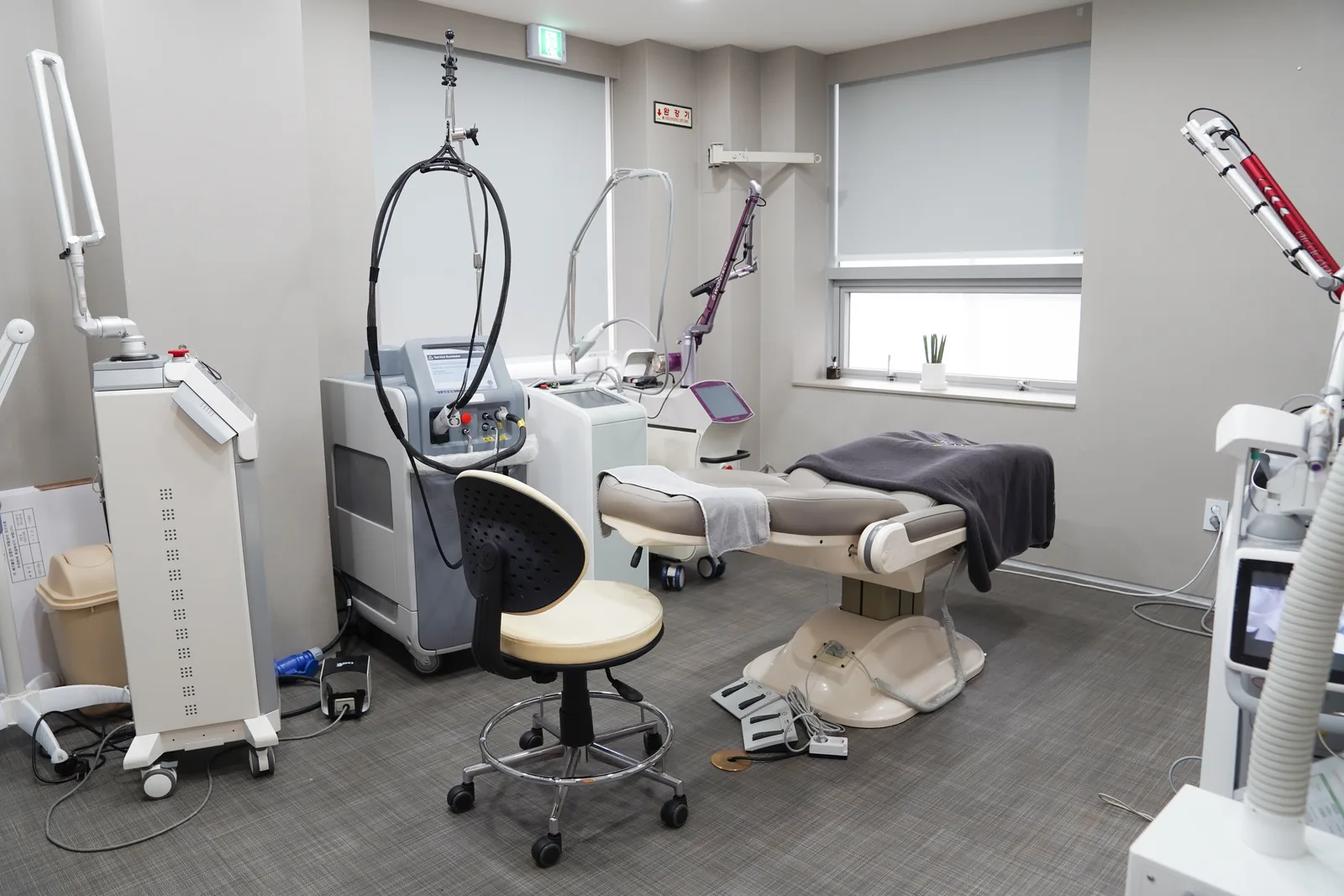
Which platform is used and at what settings is decided in the room against your ink and your skin. Comfort measures around the session are confirmed at the consultation, and a small test area may be worked first where the skin or the pigment is unusual.
The pass is quick relative to the appointment around it. Treated ink typically turns to a pale frost within seconds, which settles over the following minutes; the area is then cooled and dressed before you leave.
The clinic day around that is deliberately unhurried. The scan, the consultation and the agreed plan come before any energy is delivered, and the EVE Muse 3D imaging platform with five light sources and AI analysis carries the facial half where cosmetic brow or eyeliner ink is involved. Every session is director-performed from measurement through to dressing.
Visits are spaced by weeks, not days, because the body needs that interval to carry away the fragmented pigment. The general principle used here is a gap of six to eight weeks between passes over the same field, set against how your own skin has settled. Nobody can tell you in advance how many visits your piece will take, and a range is only written once the design has been seen in person.
Fading continues between appointments, so the design you see the day after a pass is not the one assessed at the next review. That lag is why a plan here is revised visit by visit against photographs instead of being sold as a fixed block.
None of these are hypothetical. They are the reasons energy is chosen conservatively and intervals are kept long.
Results vary between individuals. The published references at the foot of this page describe the general behaviour of laser work over ink; none of them describe your piece, and neither does this page.
Because the building runs a full range of light, energy and needle work, an ink course is never the thing that has to be sold. Where a piece is a poor candidate, saying so costs this clinic nothing.
The design is examined and photographed under fixed lighting, with the EVE Muse scan carrying the facial half where cosmetic ink is involved. A photograph sent by message is a starting point and never the assessment itself.
Your session is director-performed throughout. On ink, where energy sits close to the skin's own pigment, having the person who chose the settings also deliver them is the safeguard that matters.

| Line | Unit it is counted in | Listed rate |
|---|---|---|
| Body tattoo removal | Per five centimetres of the piece, per visit | ₩90,000 (≈ $65) |
| Eyebrow or eyeliner pigment | Per visit, cosmetic ink | ₩150,000 (≈ $105) |
Figures current for September 2026, quoted in KRW with a USD equivalent shown for orientation only. A resident of Seoul and a visitor flying in are quoted the same line for identical work. Because a course runs across weeks, the total depends on how your ink answers, and the full sheet sits on the price list.
There are pieces we turn away. We do not recommend working over skin that is sunburnt, freshly tanned, broken or infected, and that appointment is rebooked instead of run at a lower setting. Where the design sits on skin with a history of raised scarring, the conversation starts with what the end point can realistically be. Where someone is hoping to clear a large, densely packed piece inside a short holiday, we say plainly that the calendar does not allow it. And on cosmetic pigment, a test area comes before a full pass, because certain formulations darken instead of lightening.
Director-performed treatment is a Dear promise — your procedure is planned and performed by the doctors below.





Real verified reviews from our Google Business Profile.
4.9★★★★★ 310 Google ReviewsThe clinic was very professional from start to finish. Doctor Jung was excellent and gentle with the treatment. I felt well looked after and everyone was outstanding. Happy with my service!
I've visited clinic for LDM procedure. I don't speak Korean, so there was an interpreter who assisted me while consulting. The staff was very attentive, they asked me every time before applying products/covering my face during the procedure and it went smoothly. Planning to visit the clini…
All the staff are kind, the doctor is professional. They recommended us the treatment that fit us best and last the longest. A very nice experience overall.
I did a hydrofacial, white/black head removal, and 1 day lasers. Really kind staff and reasonable prices. The only thing I would advise is that your first consultation is with a salesperson and you don’t see the doctor until after you decide what you want and after you pay.
Had a great experience here as a foreigner! The doctors and staff were knowledgeable, friendly, and not pushy. They made recommendations in my consultation and were happy to work within my budget.
Your questions, answered in English as soon as possible.
The references below cover the field this guide describes: two reviews of the fundamentals and practical approach to laser tattoo removal, a clinical comparison of laser configurations, and a retrospective evaluation examining safety, efficacy and the scale clinicians use to estimate how a piece will behave.
Each carries a resolvable DOI from an indexed journal. They describe general principles of ink clearance and the factors that shape it; they do not describe your own tattoo, and outcomes vary between individuals.
References are provided for information — outcomes vary by individual and are assessed at your diagnosis.